

References
Nature Energy Kværs A/S
Linka® and EUROmilling’s Straw Handling System optimizes biogas production.
Nature Energy’s new biogas plant in Kværs is yet another innovative approach to green energy. Using advanced technology, it transforms organic waste from farmers, industry, and citizens into CO2-neutral biogas.
The biogas is produced through a process where bacteria at approximately 50°C convert biomass into biogas and liquid fertilizer.
After purification, the biogas can be distributed to various sectors, potentially replacing fossil fuels in transport, industry, and heating.
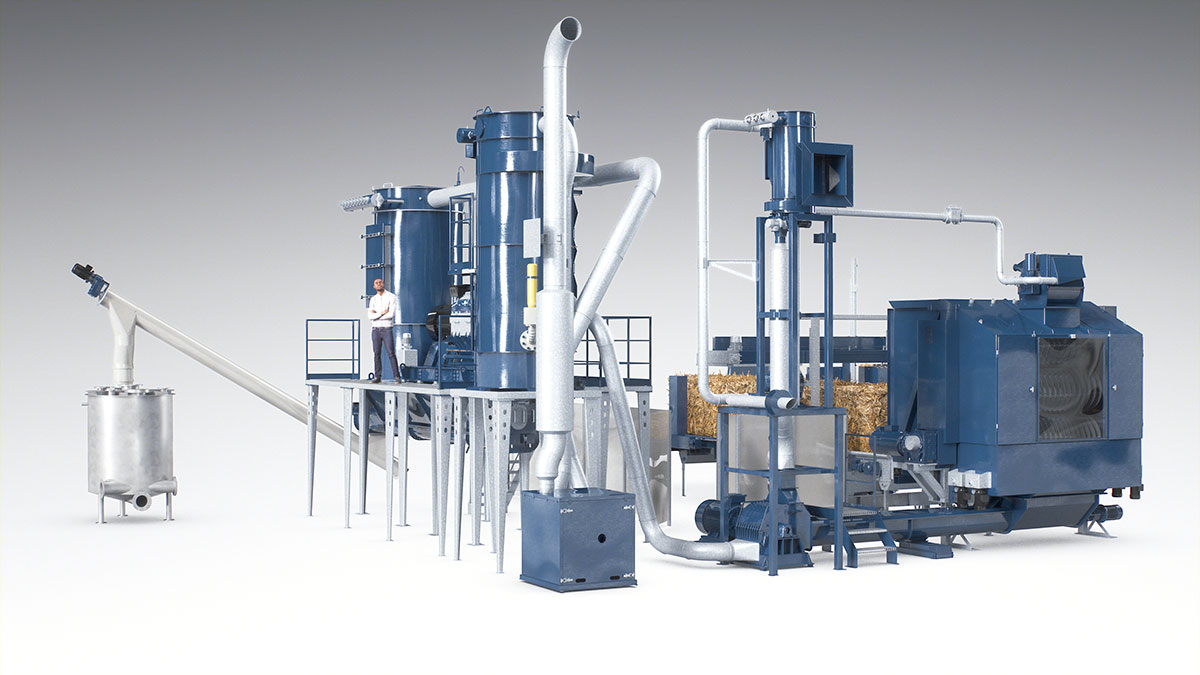
This case highlights Linka Energy and EUROmilling’s complete straw handling system for Nature Energy Kværs. The system includes a thermal and mechanical straw treatment plant that fully breaks down the straw, which is then utilized in the next stage of the biogas plant for biogas production.
The complete plant.
Linka® Straw Handling System.
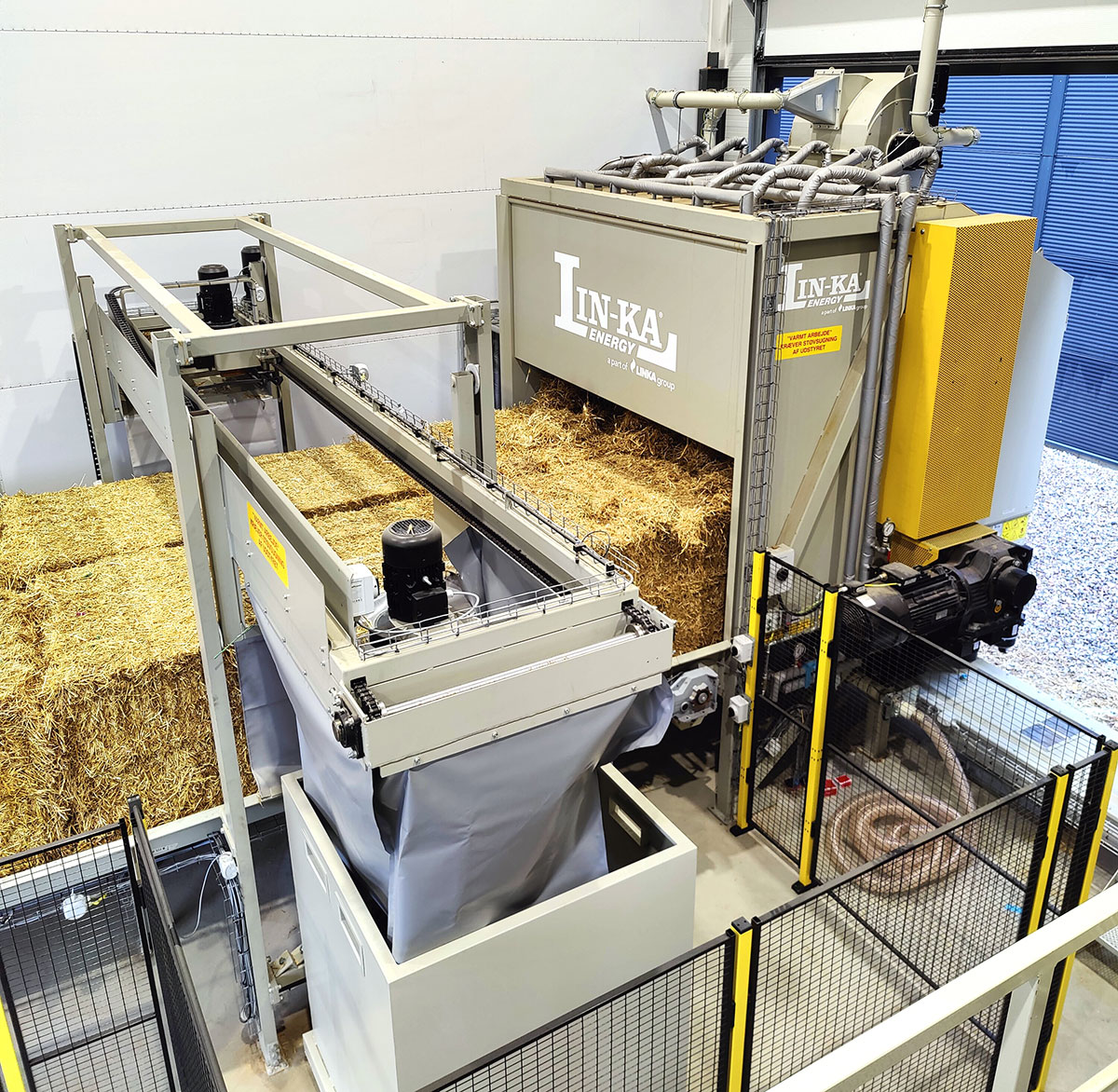
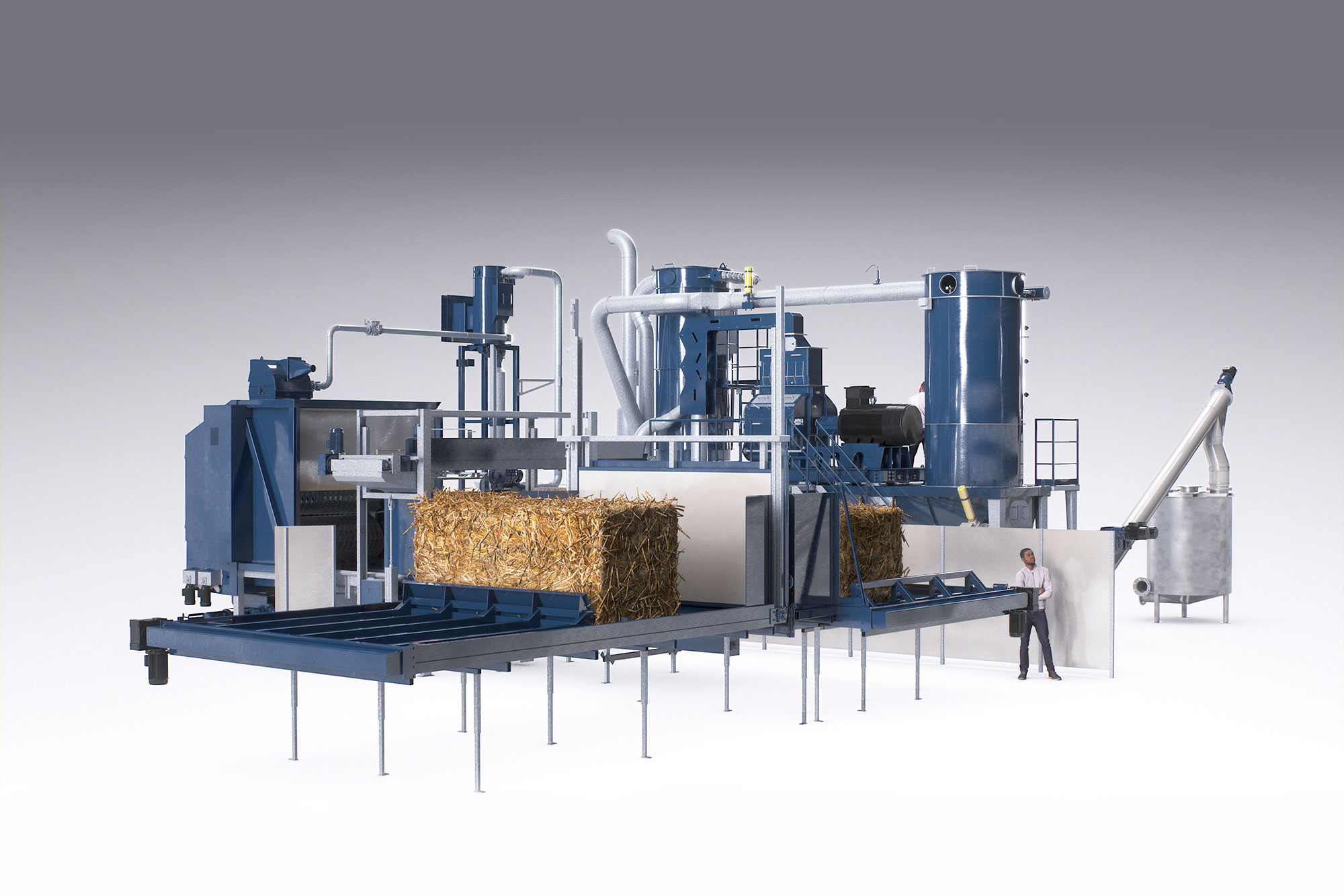
The plant is equipped with a Linka® Straw Handling System designed to manage straw bales in midi-big and Heston bale sizes. The entire process begins at the straw storage area, where the straw crane delivers a bale to a metal detector. The detector scans the bale, and the crane either moves it to the straw conveyor or directs it to a rejection area if metal is detected.
Straw Crane.
An overhead straw crane is a crucial tool for handling straw bales in storage facilities, designed to efficiently transport, lift, and position straw bales. The installed overhead straw crane automatically places the bales on the straw conveyor and can handle up to 4 tons of straw per hour.
The crane is delivered with a local control panel and operates as a PLC-controlled unit with a user interface for both crane operation and system information display. The crane control is integrated into the SCADA system.
Safety features ensure the crane operates within secure parameters. The crane is linked to door and gate safety systems in the work area. If a door or gate is opened, all crane movements, except the grab function, are halted to prevent the accidental dropping of a straw bale.
When the system requests straw, the straw crane receives a signal to fetch a straw bale.
Pusher Table (Straw Table).
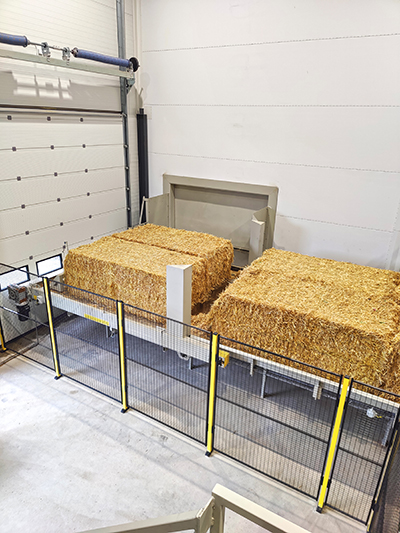
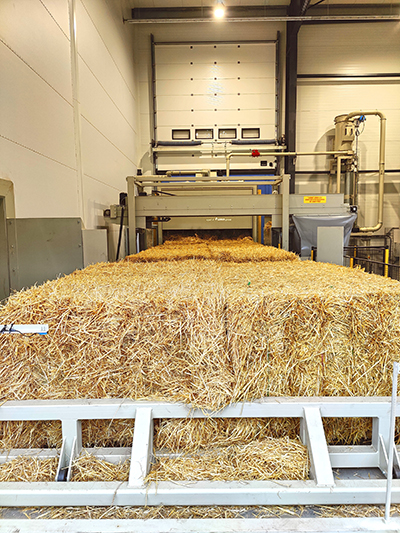
The pusher table, or straw table, is a Linka® TWIN model. This means two bales are positioned side by side along the entire length of the table, from the rear end to the shredder.
Straw bales are placed individually on the first pusher table before being moved through the fire damper and onto the next pusher table. Once two bales are positioned on the pusher table, they are pushed onto the straw table, which transports them to the string remover.
String remover
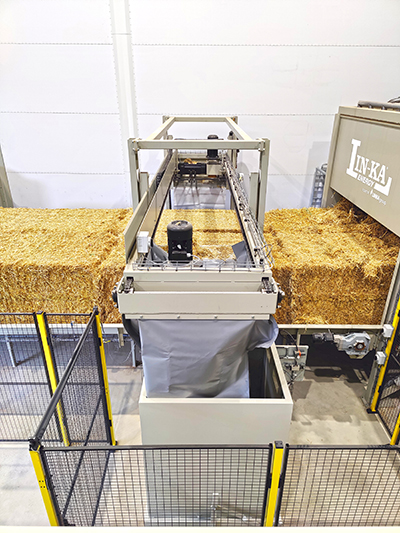
Before the straw bales enter the shredder, the strings must be removed. This process is performed automatically by a Linka® String Remover, specifically designed to prevent strings from tangling around the shredder drums.
The string remover uses photocells to position the bales accurately. The strings are then cut from underneath the bale and pulled off from above. The removed strings are wound up and separated from the straw. They are collected in a big bag, container, bucket, or a similar receptacle.
When a straw bale has had its strings removed, it continues forward towards the shredder. The photocell, now no longer interrupted, sends a signal to the straw crane to retrieve new straw bales. After the string remover, the straw shredder starts up upon receiving a signal from the straw mill.
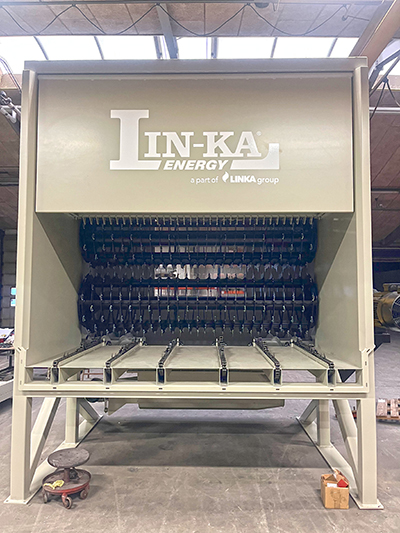
Straw Shredder.
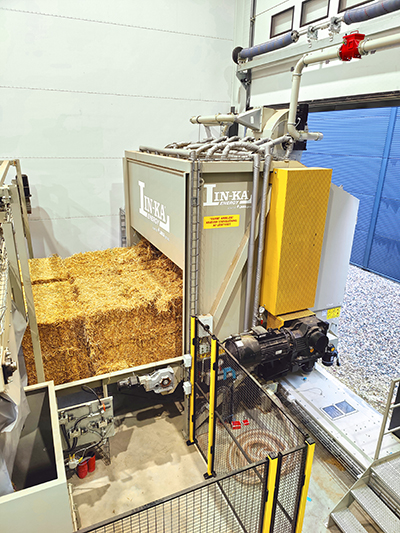
The straw shredder is a Linka® TWIN model 123, meaning two bales are positioned side by side as they enter the shredder. Inside, the straw is shredded by three drums that both cut and separate the straw fibers before they fall into the collection bin. The drums operate at low speed, which reduces energy consumption and lowers the risk of sparking.
The drums operate at low speed, which reduces energy consumption and lowers the risk of sparking. When the hammer mill ”calls” for fuel, the shredding procedure begins. This means the shredder starts by ”cutting” the two straw bales positioned inside the shredder. Here, the straw is lifted by the shredder’s drums and falls into a trough on the opposite side.
At the bottom of the trough in the shredder, two augers, one right-hand threaded and one left-hand threaded, move the shredded straw to a common, centralized outlet at the center of the shredder. From there, a double auger conveyor transports the shredded straw to the pre-mill.
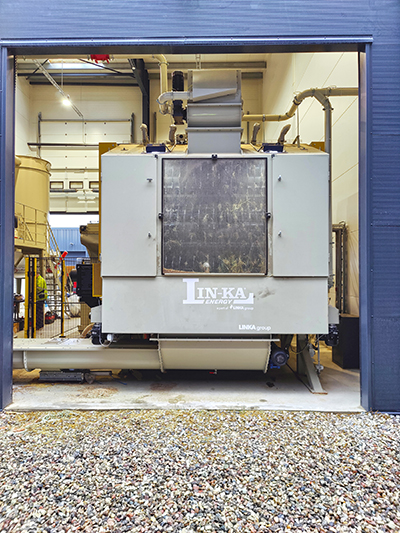
EUROmilling Grinding System
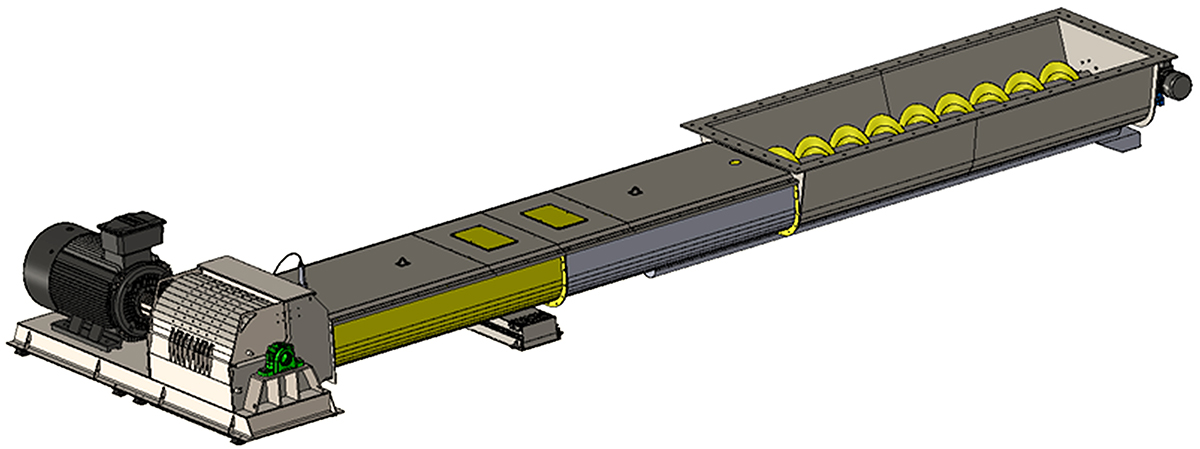
The system consists of an EUROmilling grinding setup that handles the shredded straw and includes a pre-mill, a hammer mill, and a pre-mixer.
- Pre-grinder: Prepares the straw for fine grinding;
- Hammer mill: Ensures the straw reaches the desired fine particle size;
- Pre-mixer: Homogenizes the straw for optimal biogas production.
From the shredder, the shredded straw is transported via a double auger conveyor to the pre-mill.
Hammer Mill for Straw Grinding.
The hammer mill, is a filling, grinding, and mechanical transport system that integrates all functions related to the grinding process and the mechanical transport of the finished ground straw.
Grinding occurs between hardened, loosely suspended hammers and grinding components, with wear-resistant components at the top of the grinding chamber optimizing the grinding process. These components prevent unnecessary rotation of the shredded straw, thereby increasing grinding efficiency by reducing energy consumption, minimizing wear on screens, limiting heat generation, and shortening residence time in the grinding chamber.
The grinding fineness and particle size distribution of the product are determined by the type and size of the welds.
Complete with integrated motor platform on vibration dampening kit the system includes a safety switch for the top cover, as well as a service and cleaning hatch.
The bottom outlet is equipped with an air vacuum from the fan, which draws the finished ground material through the screen, increasing capacity and cooling during the grinding process.
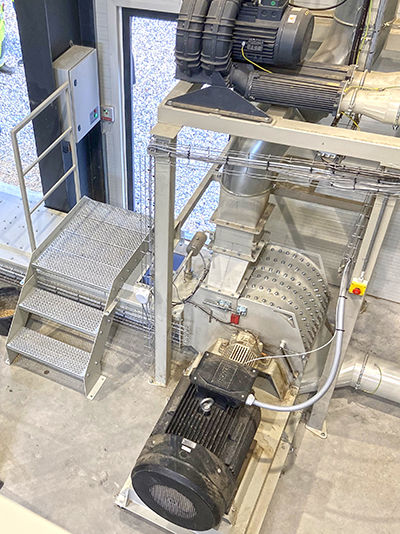
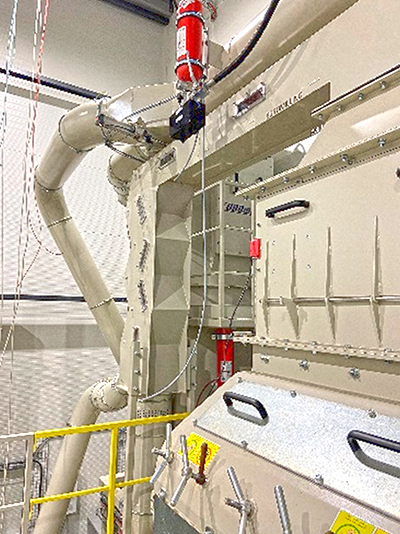
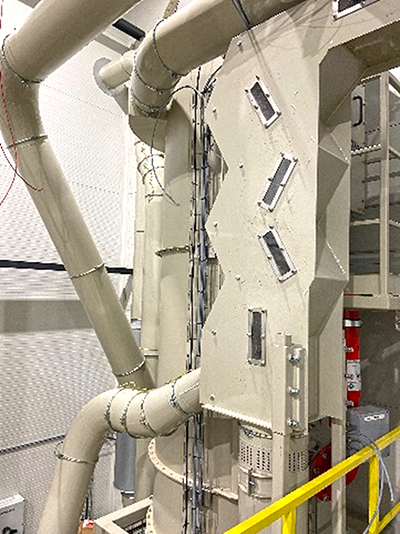
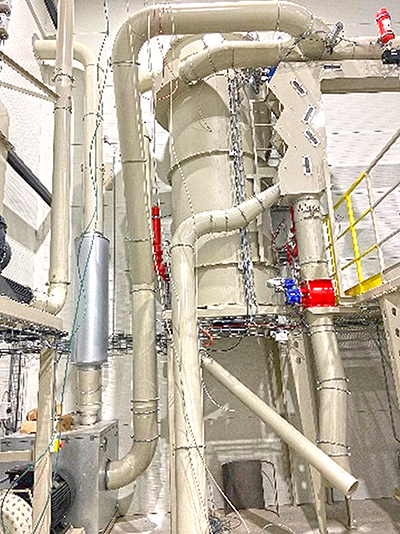
Hammer Mill, Grinding Process.
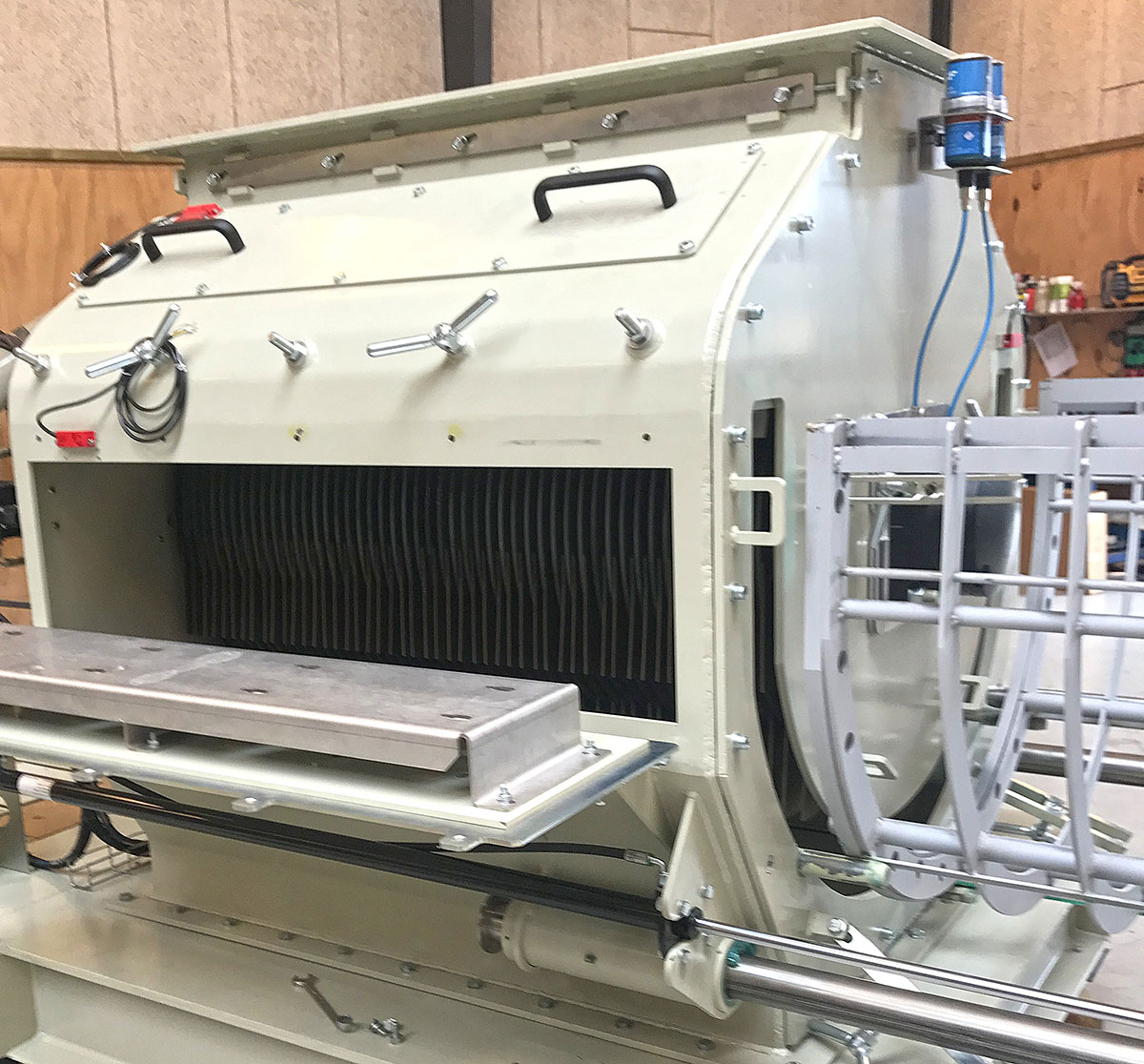
The hammer mill, type EUBL, is an efficient grinding solution that integrates metal and stone separation, air filter, fan, and a lower hopper with an extraction auger for dust-free operation. Grinding occurs between loosely suspended hardened hammers and durable, replaceable concave components at the top of the grinding chamber. The mill is reversible, which extends service intervals and optimizes energy consumption by preventing unnecessary rotation.
The hydraulically operated screen drawer allows for quick screen replacement, which determines the grinding fineness and particle size distribution. A vacuum fan is connected to increase capacity and cool the product during the grinding process. The mill is controlled by a variable frequency drive with a common mode filter and is equipped with vibration dampeners.
The rotor is fitted with insert-hardened hammers arranged in multiple rows to ensure consistent grinding. The magnetic separator removes heavy particles, while the air separator ensures high separation of stones and metal before the inlet. Sorted-out elements are pneumatically conveyed to a collection point in a Bigbag or container via the valve. Air intake occurs through a suction pipe, which continuously transports the material to the inlet and distributes it evenly with adjustable damper plates.
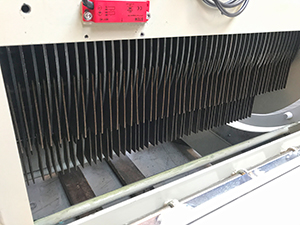 Filter.
The self-cleaning nozzle filter, Teflon-coated and anti-static, with round filter bags ensures a dust-free installation. During operation, it is self-cleaning using air pressure across multiple sections, and the cleaning process is managed by a filter control panel.
Pre-mixer.
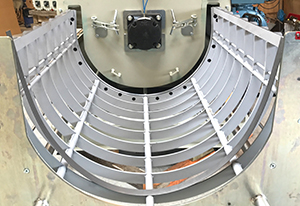 The pre-mixer is a vessel that ensures uniformity in the finished ground or shredded straw, optimizing it for the fermentation and digestion processes to achieve optimal biogas production.
From the hammer mill, the finished ground or shredded straw is transported via an auger conveyor to the pre-mixer. Here, the fermentation and digestion process begins, breaking down the straw into organic materials by microorganisms under anaerobic (oxygen-free) conditions.
Under anaerobic conditions, microorganisms decompose the organic materials into biogas through a fermentation and digestion process, producing biogas consisting of methane (CH₄) and carbon dioxide (CO₂), which is crucial for the production of methane and other gas forms. The result of methane production largely depends on the particle size of the shredded straw and its moisture content.
Control and Monitoring System.
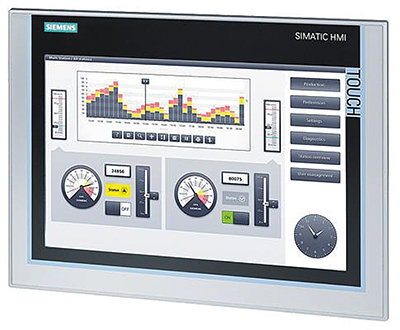 A complete control and monitoring system for the operation of the entire facility, managed from a separate control panel via the main panel. The control and monitoring system oversees, optimizes, and protects the operation, ensuring efficiency, safety, data collection, and remote control.
The control and monitoring system is based on PLC control, ensuring a controlled and logical feeding of straw bales and the hammer mill based on agreed time/signal inputs. All values and signals can be
accessed via the interface/data block in the mill monitoring PLC, either via Profinet or Profibus, according to agreed specifications. All interfaces to external control systems, such as Modbus, Profibus, Profinet TCP/IP protocols, etc., are defined in collaboration with the customer.
Electrical Installations.
Complete electrical installations, including cable ladders, cables, and other supports, for the operation of the entire facility, controlled from a separate control panel via the main panel. Complete electrical installation from the main panel to the central dust extraction system.
Central Dust Extraction System.
The central dust extraction system, wall-mounted, ATEX Zone 20, self-cleaning, and automatic (compressed air), is designed with a powerful vacuum system to collect large particles such as straw, sand, and stones.
The central unit is positioned high in the mill room and connects to a fixed piping system with suction points in both the mill room and the ”straw reception area.”
There are wall-mounted hose reel units with electric activation, extendable with a hose extension, and a vacuum pipe with a suction head.
In the straw reception area, the hose reel is mounted on a swivel arm for easier vacuuming. The collected material is automatically conveyed into the straw line during the mill operation. When the hammer mill is not in operation, the dust is transferred to a container.
Specifications

Want to know more about this project?
SAFETY ABOVE ALL.
The plant at Kværs is safeguarded against fire and explosion risks from storage to the final process. B Fire-Safe Transfer of Big Bales from Storage to the Grinding Room. The purpose of the system is to ensure that a fire in the grinding room cannot spread to the straw storage area.
Fire protection is designed and constructed in accordance with ”BS60,” ensuring only a ”free opening” between the storage and the grinding room during the transfer process. The straw feeding system is part of an integrated control function between the ”straw bale overhead crane” and the ”straw shredder.” The feeding system operates exclusively by hydraulic functions, with the oil pump station located in the grinding room.
Operational Principle:
- The straw bale is placed on the ”receiving bed” in the feeding unit.
- The ”fire door” between the straw storage and the grinding room opens.
- The straw bale is transferred from the ”receiving bed” to the ”mid-position” in the grinding room.
- The fire damper closes.
- The straw bale is transferred from the ”mid-position” to the straw push table.
All functions and operations are only performed if all other functional and safety requirements are met.
Fire Extinguishing.
A sprinkler system is installed above the straw shredder, which activates at a temperature above 50°C.
The shredder is equipped with two fire suppression systems:
- A temperature-controlled system that opens a solenoid valve.
- A mechanical system with fusible links and a pressurized container, which also operates in case of a power failure.
When the sprinkler system is activated, it is triggered either by a PT100 sensor (electronic) or fusible links (mechanical). This dual system ensures that the plant still operates during a power failure.
Activation of the sprinkler system impacts a flow switch, which also triggers an alarm. Both systems stop the plant and send an alarm.
In general, ATEX-certified components are used, including rotary valves where fine dust occurs.
Nextech: Fire Protection/Spark Extinguishing System
Spark detection and extinguishing systems are specialized fire protection solutions that detect and neutralize ignition sources such as sparks and glowing particles to prevent fire or explosion. Upon detection, a fine mist of water is released under high pressure from extinguishing nozzles within milliseconds, removing the thermal energy of the ignition source. The system can be adapted with other extinguishing agents as needed.
These systems only protect installed areas and detect infrared radiation. Compliance with fire and explosion safety regulations is required. GreCons systems are certified by VdS (E 8850001) and FM (NC 5AO.AY, OT 1A2.AY).
Note that interfaces to external control systems, such as Modbus, Profibus, and TCP/IP protocols (Profinet), are not described here. These specifications can be tailored and specified in collaboration with the customer as needed.
In Brief.
The plant at Nature Energy in Kværs is an extremely efficient facility with low operating costs compared to competing technologies. The StB plant from Linka Energy and EUROmilling can be combined and assembled based on your requirements for both output per hour, the size of the ground product, and can be combined with a blending tank and pump for the mixer plant.