

Automatic raw material handling system for biogas plant
Ausumgaard Biogas, in collaboration with Linka Energy A/S, has installed and commissioned a so-called “Walking Floor” solution for feedstock supply to the biogas plant.
Bioenergy MAGASINET was invited to visit Ausumgaard to hear whether the solution has lived up to expectations. Owner Kristian Lundsgaard aimed to achieve time savings and continuous operation without downtime, thus ensuring stable and reliable input of the diverse feedstocks used for biogas production.
Previous experiences have shown that the strength and durability of such a system can be a weak point, as the feedstocks are heavy and difficult to handle. Therefore, a very robust system was required — one that could withstand the pressure from the raw materials and ensure uninterrupted operation. Any interruption in feeding — and thus in biogas production — results in a loss of efficiency and energy output in a plant that ideally runs 24/7, 365 days a year.
A historic manor.
The beautiful old historic manor, Ausumgaard, is located on a hill beside the main road between Struer and Holstebro.
The household consists of Kristian and Maria, along with their three children, Sigrid, Solvej, and Rasmus. They live in the main building, from where they run a modern farm with a strong focus on sustainability and renewable energy, while also working on new concepts and niche products. Kristian is a trained farmer, and Maria is a psychologist with her own practice in Huset Lindskov, just east of Ausumgaard. All three children attend Hjerm School, which is nearby.
Since Maria and Kristian took over the farm in 2008, it has seen rapid development towards increasingly green and sustainable production. The crop area spans 700 hectares, which was converted to organic farming in 2018.
Most recently, chicken production has been leased out (previously, they produced up to 500,000 broiler chickens).
As a relatively new business area, they are currently producing mealworms in collaboration with the Danish Technological Institute under the InValuable project. Whether the production will become permanent at Ausumgaard remains to be seen, but the owners are participating because it aligns with their broader sustainability efforts.
As part of their broader crop production, they also have a small-scale niche production of bread grains, which are processed into flour and sold directly.
Today, the pig stables are leased to a breeding and multiplication herd. This means that they now only produce about 200 pigs per year themselves, under the name “Ausumgaardgrisen”.
Green energy.
The old manor has undergone a significant transition: After many years of animal production, the focus is now on crop farming and the production of green energy — especially biogas and wind power.
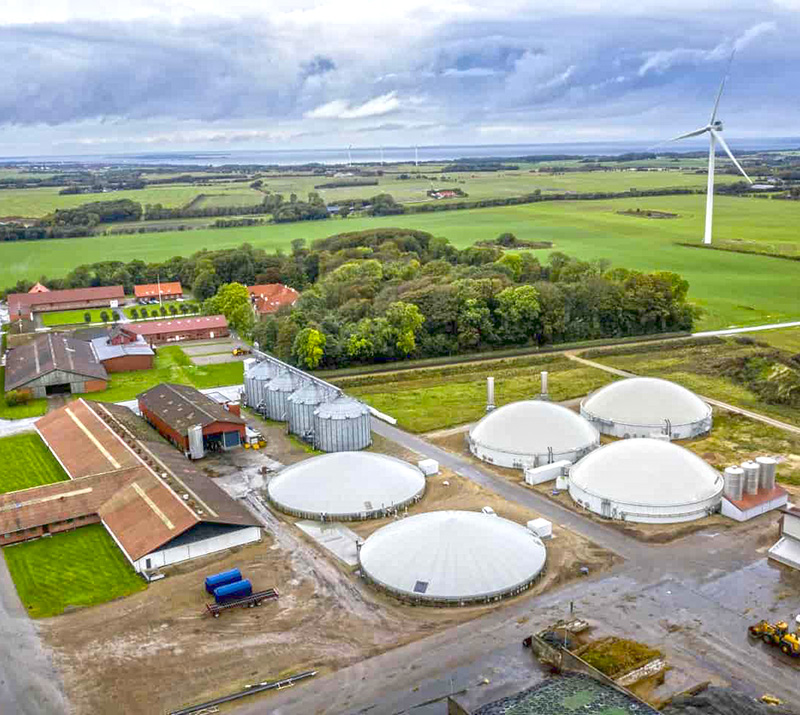
The biogas plant is situated just south and southeast of Ausumgaards existing production buildings, where two reactor tanks have been constructed to the east of the existing slurry tanks. These have a capacity of 2 × 5,200 m³, are located about 3 m below ground, and extend 4 m above the surface. Both reactor tanks are equipped with gas storage domes. The total height is approximately 12–14 m.
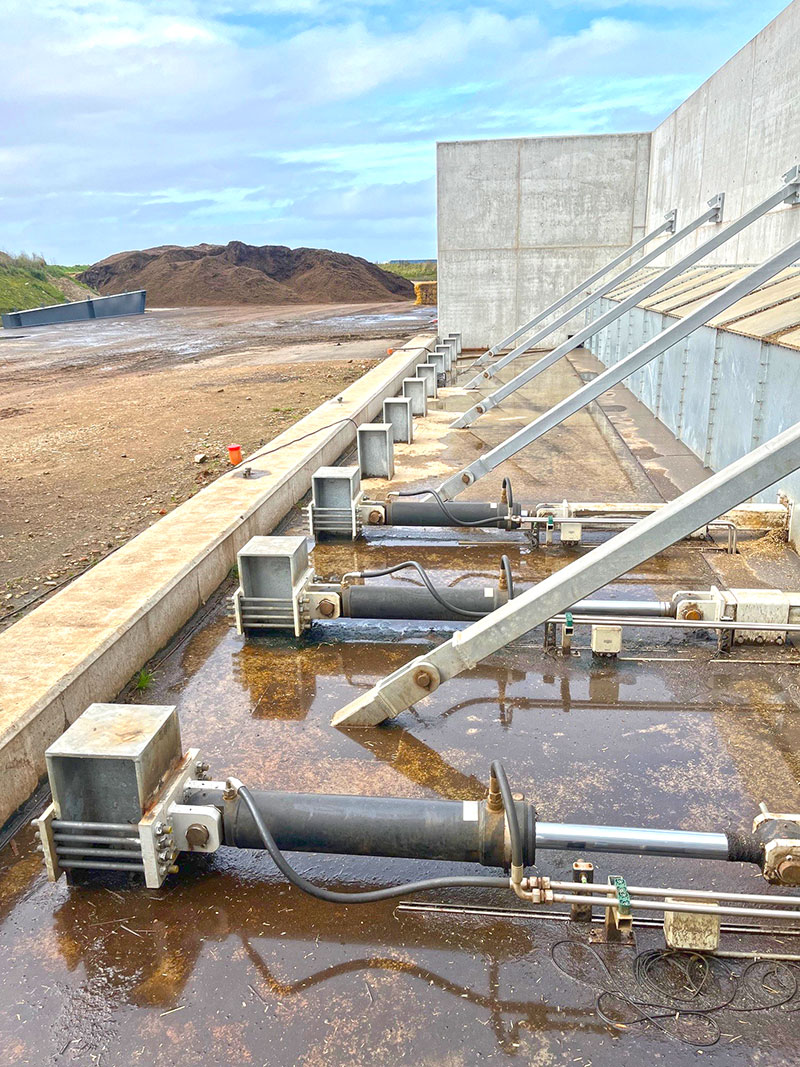
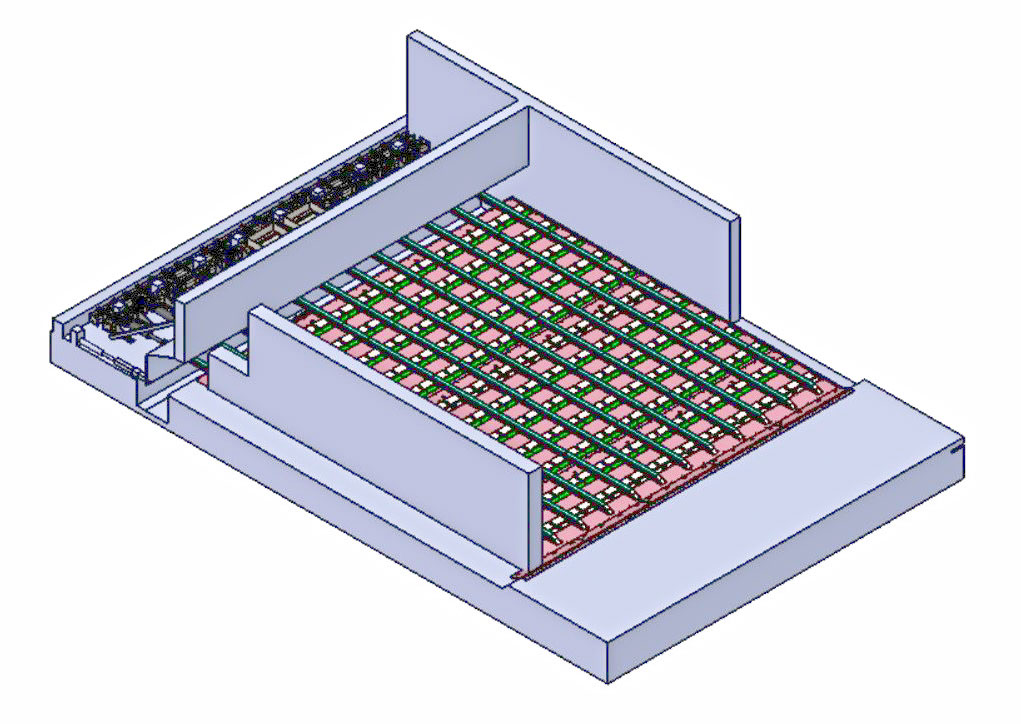
South of the reactor tanks lies the technical building, which houses control panels and pumps, as well as the biogas plant’s feeding system, which resembles a sunken truck trailer / “Walking Floor” (older farmers might liken it to a silage wagon).
Between the main road and the technical building is a large area used for storing biomass for the plant.
Access to the facility is via Ausumvej, past Ausumgaards existing weighbridge and on to the biogas plant.
Since 2017, Ausumgaard has produced biogas, which is upgraded to biomethane and fed into the national gas grid. Although biogas has many applications, this is the solution used on the farm.
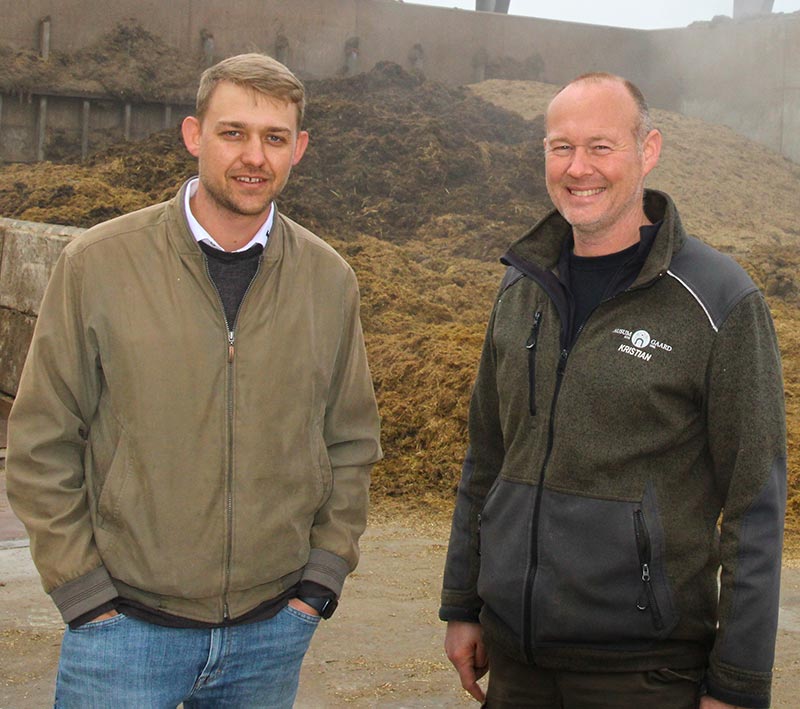
Lars Visgaard Jørgensen, Business development at Linka Energy A/S and Kristian Lundsgaard, owner of Ausumgaard Biogas.
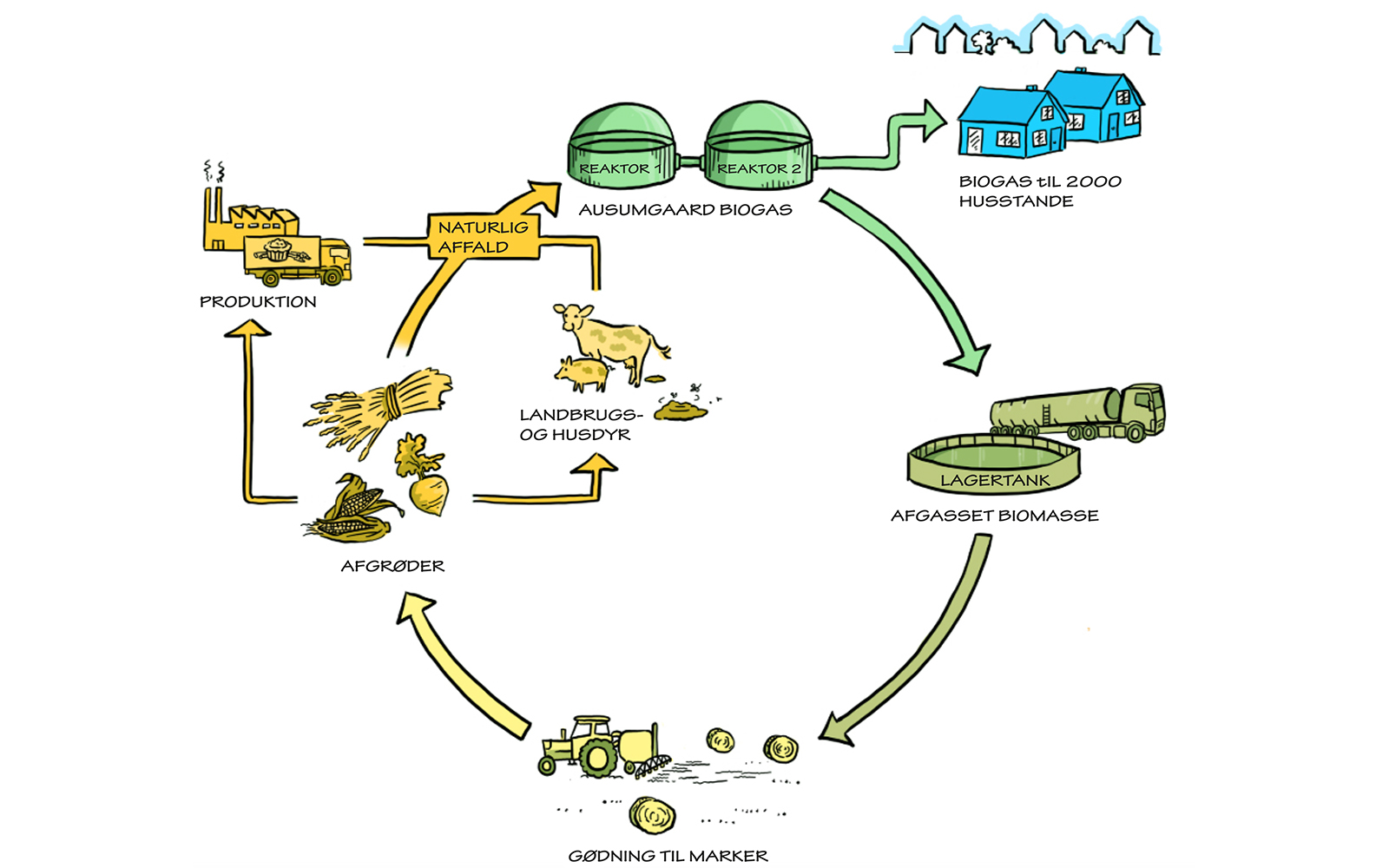
”We produce the equivalent of the annual heating demand of about 4,700 households and feed the biogas plant with biomass and by-products from agriculture, food, and energy production. In this way, we create sustainable energy from materials that would otherwise be difficult to use or potentially go to waste,”
explains Kristian Lundsgaard.
Biogas production at Ausumgaard not only creates green energy — it also delivers a valuable resource back to agriculture. Once the gas has been extracted, the degassed biomass is returned and used as fertiliser. The liquid residue from the process is much easier to apply precisely to crops than traditional deep litter manure, which is typically spread on the surface or before ploughing.
Additionally, the degassed biomass contains nutrients in a form that plants can more easily absorb. This results in more efficient nutrient use, fewer odour problems, and higher fertiliser value — benefiting both farm finances and the environment.
With this effective nutrient utilisation, many farmers can also reduce their use of synthetic fertilisers. This strengthens economic sustainability and supports the circular principles of modern food production.
Livestock farmers with deep litter from calves, dairy cattle, or poultry can particularly benefit from the solution. They can supply their manure to the biogas plant and receive degassed biomass in return — as part of a local, green cycle.
Biogas creates multiple synergies with agriculture.
The biogas plant also provides crop farmers with the opportunity to grow biomass for sale to the plant. This biomass may consist of energy crops such as maize or beets (though these are being phased out), but it may be even more relevant to supply straw, grass, ensiled seed grass straw or other “by-products” from crop production that gain greater value through use in biogas production
— especially if the degassed biomass is returned and spread on the fields.
”We’re constantly trying to stay up to date with new opportunities and new feedstocks, which is why we are increasingly focused on grass as maize is phased out,”
says Kristian.
Automatic feeding of the reactors.
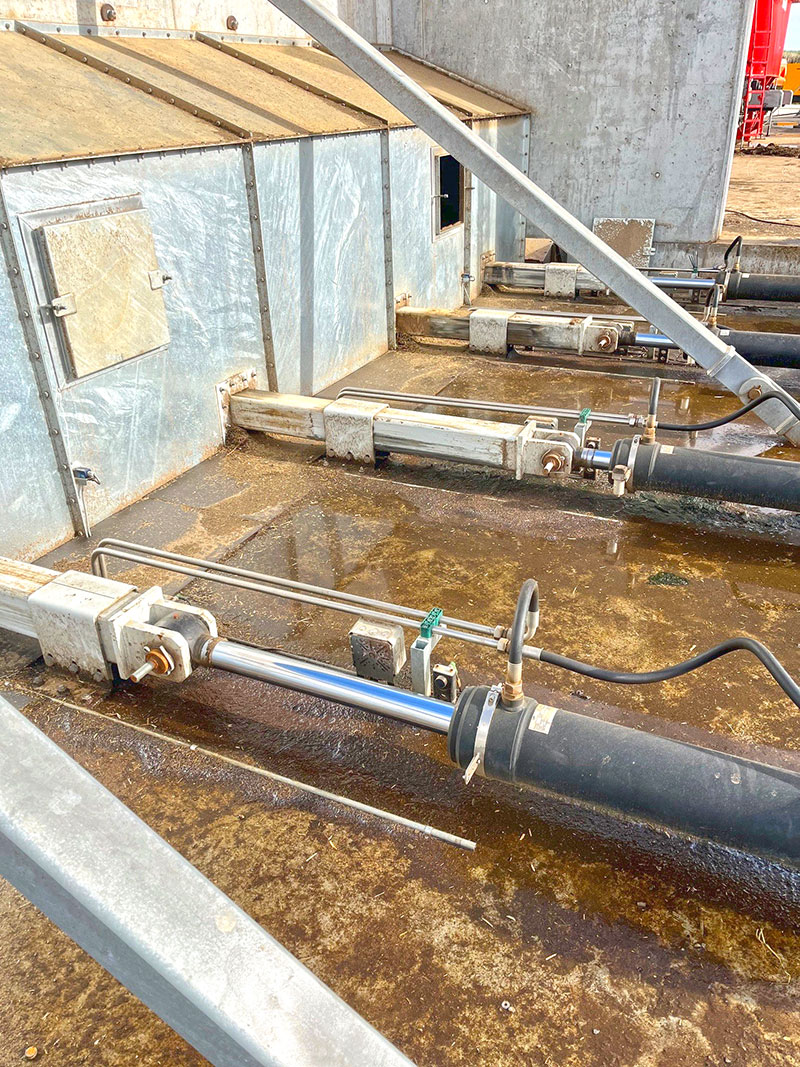
The latest investment at Ausumgaard is a so-called Walking Floor system from Linka — a highly robust and reliable solution designed to handle even the heaviest feedstocks.
The system is installed in the silage pits and can be filled up to four metres high. It has the capacity to deliver up to one tonne of material per minute. Based on an assessment of the feedstock properties, the material quality and strength have been designed for a density of 600 kg/m³.
This is a heavy-duty model that ensures stable and continuous delivery to the reactors — even under high pressure and with heavy biomass.
”In addition to the extra strength, a Hardox plate floor has been installed under all scrapers to ensure extreme durability,” says Lars Visgaard Jørgensen, Project Sales and Business Developer at Linka Energy. He continues: “We had a very productive project phase with Ausumgaard, where both parties contributed input to ensure we achieved the optimal solution.”
This solution is for those who want to avoid all the alarms associated with large crane systems and already use a wheel loader on-site, which can feed the silage pits where the Walking Floor system is installed.
The system has a capacity for 1.5 days of continuous operation.
Text and photo: Kris Vetter.

”We feel our requirements were well heard and incorporated into the design, resulting in a strong and reliable solution. There’s no doubt the system works well, and we have high expectations for our return on investment,”
says Kristian Lundsgaard – the satisfied farmer and biogas operator.