

Linka Group grows with approximately 50 new colleagues
Linka Group grows with approximately 50 new colleagues
More expertise. Stronger service. New opportunities.
Linka Group has acquired the majority of the business activities of Verdo Energy Systems A/S within service, automation, industry and smaller energy projects. With this acquisition, the Group grows to approximately 150 employees and strengthens its expertise in engineering, project management, commissioning and technical service.
On 19 October 2026, Linka Group, through its subsidiary Linka Service A/S, acquired the majority of the business activities of Verdo Energy Systems A/S.
The acquisition brings approximately 50 new employees to the Group, adding extensive technical experience and specialist expertise. This puts Linka Group in a stronger position to meet the growing demand for energy solutions and technical services within district heating and industry.
Additional expertise across the Group
The new employees will become part of Linka Group’s organisation, bringing expertise and resources that strengthen all three companies:
- Linka Energy gains additional resources in engineering, design and project management, increasing its capacity to deliver both ongoing and future energy projects.
- Weiss strengthens its service organisation with additional expertise in technical service, commissioning and automation, as well as improved geographical coverage, particularly in Northern and Western Denmark.
- Jernforsen Energy gains access to additional technical specialists and project resources to support its substantial order backlog and continued growth.
At the same time, the acquisition strengthens the Group’s presence in Denmark and creates new opportunities in the Polish market.
Stronger service and wider geographical coverage
A key focus of the acquisition is the expansion of the Group’s service activities.
With the new operations in Aalborg and Weiss’s existing service organisation, Linka Group gains additional specialists and wider geographical coverage. This strengthens our ability to support customers with technical service, maintenance, troubleshooting, commissioning and automation.
For customers who have previously worked with Verdo Energy Systems, our priority is to ensure a smooth transition and maintain established professional relationships. Many of the employees who already know these customers and their plants will continue as part of Linka Group.
A stronger partner throughout the plant’s lifetime
With approximately 150 employees and a broader technical organisation, Linka Group is further strengthening its position as a supplier and partner for energy solutions within district heating and industry.
The Group can support customers throughout the entire lifetime of their plants – from engineering and installation to commissioning, operation, service and maintenance.
The acquisition therefore provides both additional resources for delivering new projects and a stronger organisation to support existing energy plants.
Welcoming our new colleagues
We look forward to welcoming approximately 50 new colleagues to Linka Group and combining our experience and expertise to create value for both existing and new customers.
More expertise. Stronger service. New opportunities.

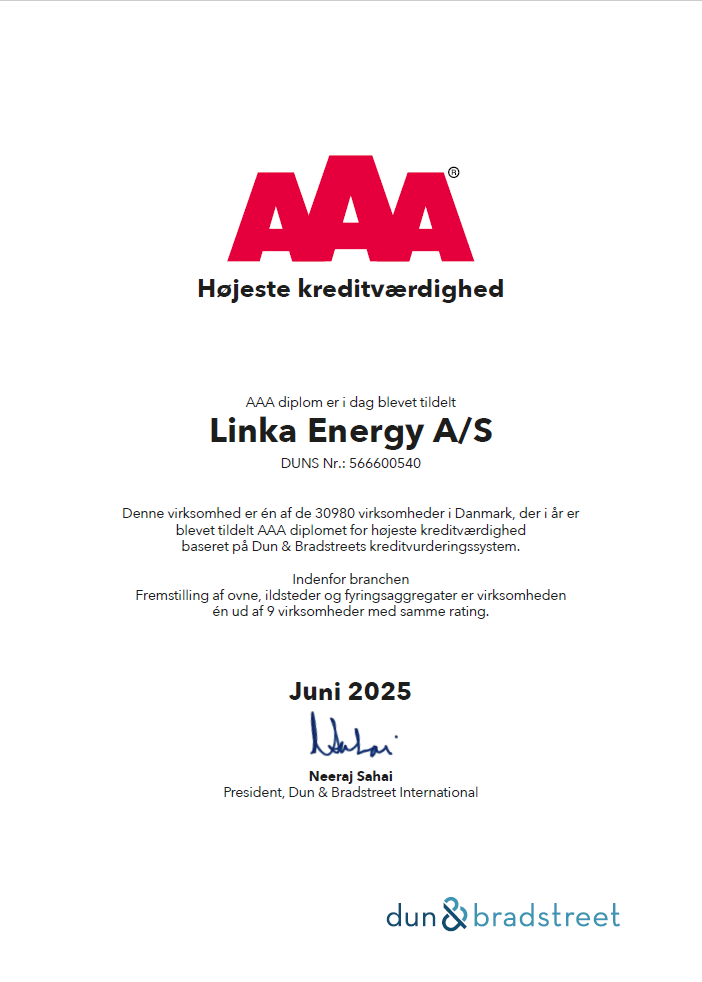
Linka Energy awarded AAA diploma for highest creditworthiness
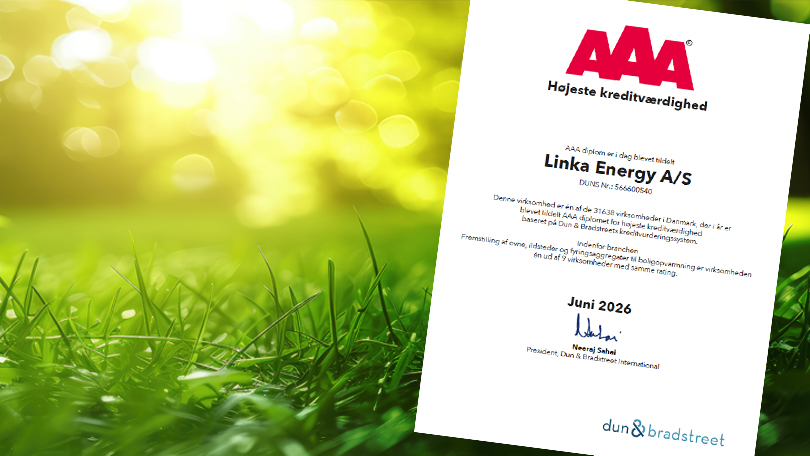
Linka Energy awarded AAA diploma for highest creditworthiness.
AAA rating – a mark of financial stability and responsibility.
At Linka Energy, we work every day to deliver sustainable energy solutions – but our focus goes beyond technology and projects. It’s also about responsibility, trust, and financial stability.
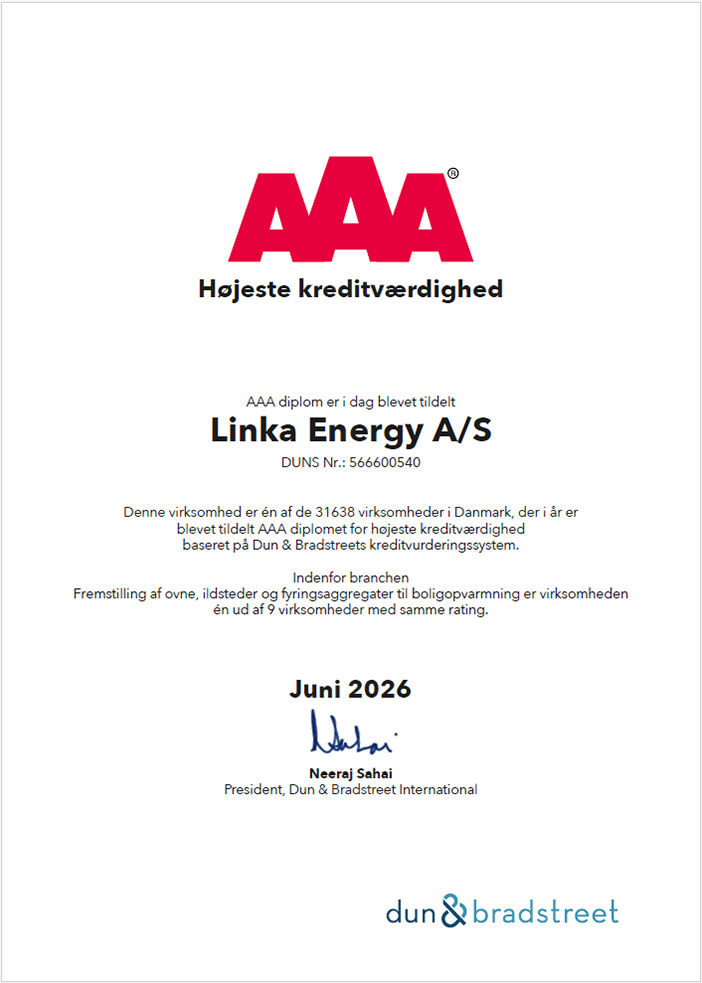
That’s why we’re proud to announce that we have been awarded the AAA diploma by Dun & Bradstreet – the highest possible credit rating a company can achieve.
What does a AAA rating mean?
A AAA rating signifies outstanding financial health. It shows that Linka Energy has an exceptionally strong ability to meet its financial obligations, with a very low risk of default. In practical terms, it means we are among the most financially stable and reliable companies in Denmark.
Why is this important?
This rating carries significant meaning for our customers, suppliers, and partners:
- For our customers, it’s a clear sign that they are working with a company that is well-managed and delivers on its promises.
- For our suppliers, it confirms that we are a responsible business partner who pays on time.
- And for financial stakeholders, it demonstrates that we are a trustworthy actor – opening the door to attractive financing opportunities.
How is a AAA rating achieved?
Dun & Bradstreet evaluates companies based on a combination of factors, including:
- Financial key figures
- Payment history
- Company structure and ownership
- And a wide range of other parameters that together provide a comprehensive picture of a company’s financial health.
Only a small percentage of Danish companies meet the strict criteria required to obtain the AAA diploma – which makes us all the prouder to be among them.
A collective achievement.
This recognition is more than just a certificate on the wall – it is a testament to the dedication and responsibility shown by everyone at Linka Energy, every single day.
We would like to thank all our employees, customers, and partners who have contributed to making this achievement possible.
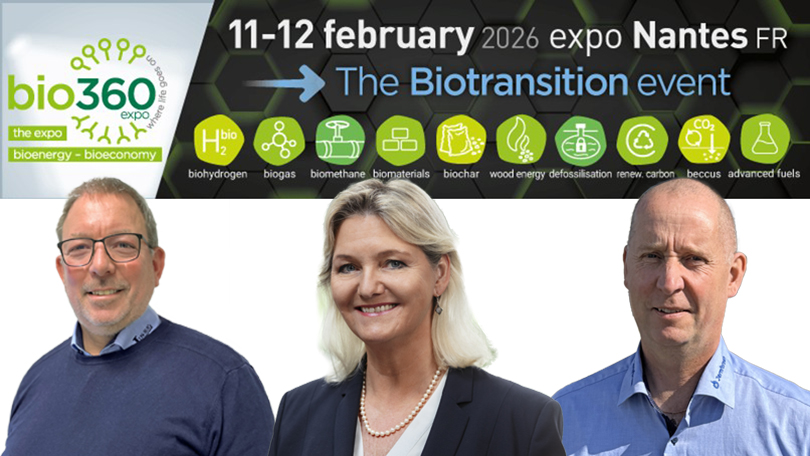
BIO360 Nantes 2026
Linka Energy at BIO360 Nantes 2026
Biomass and fuel flexibility in focus.
When BIO360 Expo 2026 takes place in Nantes, Linka Group will participate with a strong focus on biomass and waste-based energy solutions that support the green transition through efficient use of local resources.
At the exhibition, we will present our boiler systems delivering heat – and, in relevant projects, also power – based on a wide range of biomass and waste-derived fuels.
From straw, forestry and garden residues to recovered wood and RDF, we demonstrate how flexible technology enables stable and sustainable energy production.
Fuel flexibility taken to a new level.
Linka Group’s boiler systems are engineered for maximum fuel flexibility and can handle fuels with moisture contents of up to 60%.
This provides district heating utilities and industrial customers with the freedom to utilise locally available fuels – even when fuel quality and composition vary.
With more than 4,000 reference plants in operation worldwide, ranging from approximately 200 kW to 35 MW, our solutions are based on documented operational experience and proven technology.
The result is high efficiency, stable operation, and effective energy utilisation – sustainability in practice.
Local resources – global experience.
BIO360 is an international platform for bioenergy, and here Linka Group demonstrates how Scandinavian quality and decades of experience are translated into robust energy solutions across countries and markets.
Today, our systems are used in both the utility and industrial sectors, where requirements for operational reliability, emissions, and plant lifetime are high.
Meet us at BIO360.
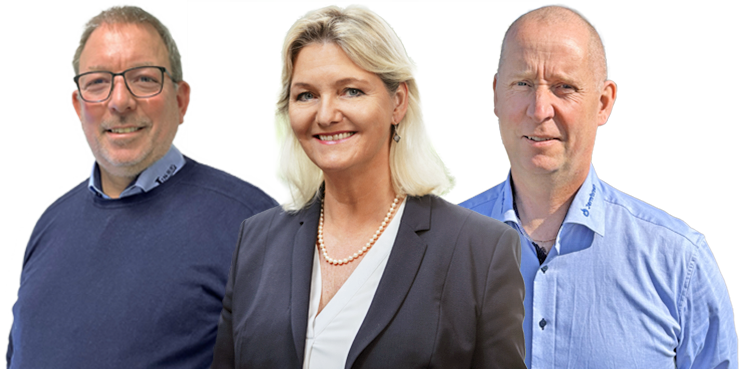
Visit Linka Group at Stand F28 in the Danish Pavilion, and meet Ann Bouisset, Claus Mikael Larsen, and Magnus Extergren for a professional dialogue on biomass, fuel flexibility, and future energy solutions.
We look forward to sharing experience and discussing how local fuels can be converted into efficient, reliable, and sustainable energy.
Linka Group consists of Linka Energy, Jernforsen Energy AB and Weiss ApS, together delivering complete and reliable solutions within biomass- and waste-based energy production.


Christmas greetings 2025
Thank you for an eventful 2025
– and welcome to a new chapter
As the year draws to a close, we look back on a 2025 characterised by progress, strengthened partnerships, and an important strategic shift. At Linka Group, we are proud that the year once again demonstrates how far we can go when expertise, collaboration and commitment go hand in hand.
In 2025, we delivered numerous new plants to both existing and new customers, and we entered markets where we had not previously been represented.
2025 was also the year in which Brian Pedersen transferred the majority shareholding in Linka Group to Christoffer Lassen and the investment company Kincap. This change of ownership marks the beginning of a new chapter in Linka Group’s history and brings new resources, networks, and competencies to support the Group’s development and international expansion.
“It has been important for me to find the right majority owners so that the positive development can continue,” said Brian Pedersen.
”I see significant opportunities for Linka Group – within its current segments, geographically, and by applying its market-leading technology in new areas – and I have great respect for what the Group’s companies have already achieved”, said Christoffer Lassen.
As we look towards 2026, we do so with strong optimism, a solid order book, and many projects in the pipeline.
Our focus is clear: continued growth, innovation, and green development through reliable and efficient energy solutions.
We will strengthen our service business, expand internationally, and continue to deliver technological solutions that make a real difference for industry, agriculture, and district heating.
Thank you to all our customers, partners, and colleagues for your cooperation in 2025.
Your trust is the driving force behind our success.
We wish you a Merry Christmas and a prosperous, green and forward-looking 2026.

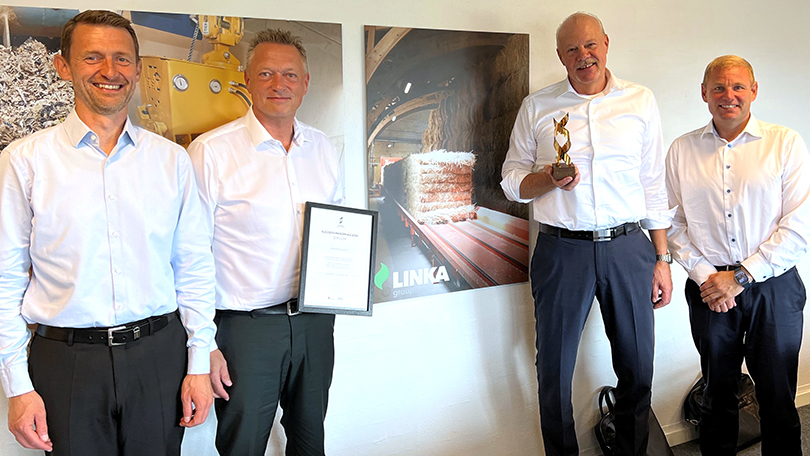
Linka Energy among this year’s Success Companies
Linka Energy among this year’s Success Companies
Linka Energy has been recognized as one of Denmark’s Success Companies 2025 – a business award founded by Spar Nord and BDO to celebrate companies that significantly contribute to growth and development in Danish business.
The award is presented annually to 1,000 small and medium-sized companies, distributed across Denmark’s five regions. Selection is based on financial performance over five years, including growth in profit and equity, and the ability to create results from the given capital base.
“Being recognized as a Success Company is a great acknowledgement for our entire organization. It shows that we have a solid business while also contributing to growth and development in Denmark,” says Thomas Gaardbo, CEO, Linka Energy A/S.
With this award, Linka Energy receives a statuette as proof of our achievements – and as a symbol of the dedication, competence, and sound business model that made it possible.
Press release: Brian Pedersen sells majority shareholding in Linka Group to Christoffer Lassen and Kincap
PRESS RELEASE
for Linka Group
Brian Pedersen sells majority shareholding in Linka Group to Christoffer Lassen and Kincap.
Biomass and waste-to-energy specialist Linka Group welcomes new majority owners. Brian Pedersen has chosen to sell his majority shareholding in the company to experienced business investor Christoffer Lassen and the Danish investment firm Kincap.
The sale marks a new chapter in Linka Group’s development.
The new shareholders – together with selected members of the management team and current principal shareholder Brian Pedersen – will form the ownership group of Linka Group going forward and will further strengthen the expansion of the company’s activities.
The partnership with Christoffer Lassen and Kincap will bring the group additional resources, experience and networks.
”I know there is considerable potential to further develop our companies, and it is fantastic to strengthen our opportunities through the resources that the new co-owners bring into the group,” says Thomas Gaardbo, CEO of Linka Group.
Christoffer Lassen, who will become the new Chairman of the Board at Linka Group, brings extensive experience in complex commercial matters, the establishment and operation of similar businesses, and the use of his wide network.
”In my decision to invest in Linka Group, it has been crucial that the companies have a very solid foundation that can be developed further. I see significant opportunities for Linka Group, both within its current market segments and geographically, as well as in applying its market-leading technology to new areas – and I have great respect for what the group’s companies have already achieved,” says Christoffer Lassen.
Kincap is a Danish investment firm that invests in well-established small and medium-sized companies, with a mission to help them become larger and stronger.
Kincap brings together family offices to create strong growth platforms for capable and ambitious management teams.
”We see great potential in Linka Group. It has been important to us that the current management and board take part in the continued journey of Linka Group, as this complements our capabilities in building the strongest possible team. We look forward to working with the talented people in the group and to driving further development,” concludes Nils Smith, Partner & CEO of Kincap Management.
About Linka Group:
With almost 100 employees in Denmark and Sweden, Linka Group – consisting of Linka Energy A/S, Jernforsen Energy AB and Weiss ApS – has, for nearly 50 years, supplied boiler plants, handling systems and support solutions for industry, agriculture and district heating plants – both nationally and internationally.
In recent years, the company has experienced solid growth in both revenue and earnings, and the new investors will help accelerate this development.
About Kincap:
Kincap is a Danish investment firm that invests in well-established small and medium-sized companies, with a mission to help them grow larger and stronger.
Kincap enters into close partnerships with capable and entrepreneurial management teams to further develop strong businesses.
Kincap is ambitious yet informal and contributes systematically and structurally with knowledge, networks, and capital.
Kincap is built on the values and culture of family-owned businesses, combined with strong experience from active ownership.
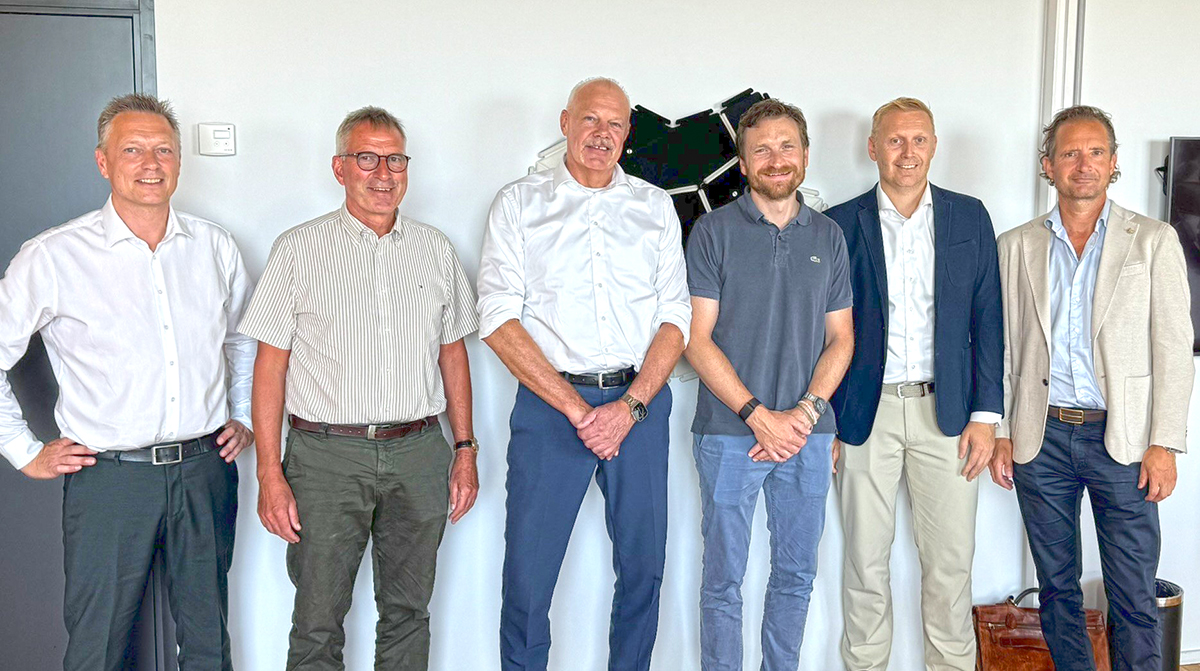
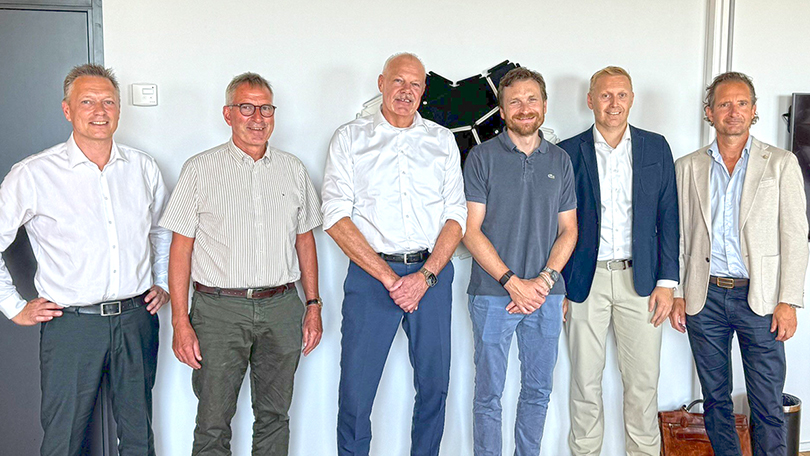
From left to right: Thomas Gaardbo (CEO, Linka Group), John Veje (Board Member, Linka Group), Brian Pedersen (Board Member, Linka Group), Nils Smith (Partner & CEO, Kincap Management), Christoffer Lassen (CHBL Holding ApS), and Mads Pauli Ringkjøbing-Christiansen (Partner & Chairman of the Board, Kincap Management).
For further information:
Thomas Gaardbo, CEO, Linka Group, +45 20 36 04 26, thg@linka.dk
Nils Smith, Partner & CEO, Kincap Management, +45 24 78 33 57, nils@kincap.dk

Brian Pedersen, who will remain a co-shareholder and board member, says:
“It has been important for me to find the right majority owners for the company so that its positive development can continue. With Christoffer Lassen and Kincap, Linka Group gains owners who both share our values and recognise the significant opportunities in the market. I am confident that their experience and ambitions will strengthen our position and growth. At the same time, I would like to highlight the great efforts made every single day by our skilled employees in Denmark and Sweden – without their expertise, dedication and professionalism, we would not be where we are today.”
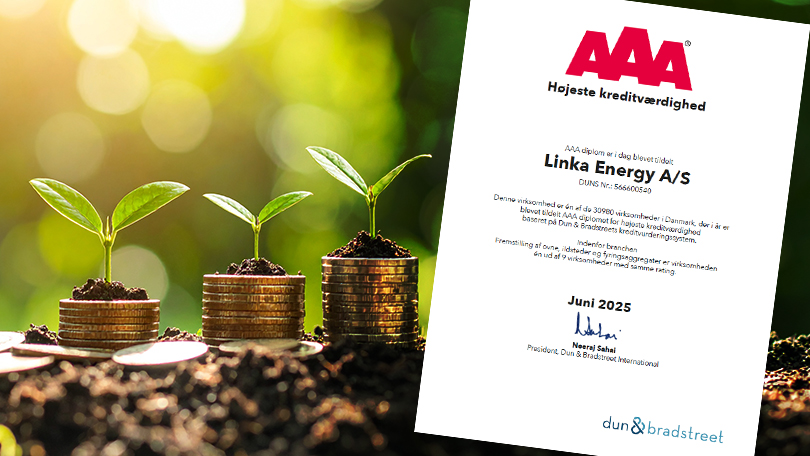
Linka Energy awarded AAA diploma for highest creditworthiness
Linka Energy awarded AAA diploma for highest creditworthiness
AAA rating – a mark of financial stability and responsibility
At Linka Energy, we work every day to deliver sustainable energy solutions – but our focus goes beyond technology and projects. It’s also about responsibility, trust, and financial stability.
That’s why we’re proud to announce that we have been awarded the AAA diploma by Dun & Bradstreet – the highest possible credit rating a company can achieve.
What does a AAA rating mean?
A AAA rating signifies outstanding financial health. It shows that Linka Energy has an exceptionally strong ability to meet its financial obligations, with a very low risk of default. In practical terms, it means we are among the most financially stable and reliable companies in Denmark.
Why is this important?
This rating carries significant meaning for our customers, suppliers, and partners.
- For our customers, it’s a clear sign that they are working with a company that is well-managed and delivers on its promises.
- For our suppliers, it confirms that we are a responsible business partner who pays on time.
- And for financial stakeholders, it demonstrates that we are a trustworthy actor – opening the door to attractive financing opportunities.
How is a AAA rating achieved?
Dun & Bradstreet evaluates companies based on a combination of factors, including:
- Financial key figures
- Payment history
- Company structure and ownership
- And a wide range of other parameters that together provide a comprehensive picture of a company’s financial health.
Only a small percentage of Danish companies meet the strict criteria required to obtain the AAA diploma – which makes us all the prouder to be among them.
A collective achievement
This recognition is more than just a certificate on the wall – it is a testament to the dedication and responsibility shown by everyone at Linka Energy, every single day.
We would like to thank all our employees, customers, and partners who have contributed to making this achievement possible.
Ausumgaard Biogas
Automatic raw material handling system for biogas plant
Ausumgaard Biogas, in collaboration with Linka Energy A/S, has installed and commissioned a so-called “Walking Floor” solution for feedstock supply to the biogas plant.
Bioenergy MAGASINET was invited to visit Ausumgaard to hear whether the solution has lived up to expectations. Owner Kristian Lundsgaard aimed to achieve time savings and continuous operation without downtime, thus ensuring stable and reliable input of the diverse feedstocks used for biogas production.
Previous experiences have shown that the strength and durability of such a system can be a weak point, as the feedstocks are heavy and difficult to handle. Therefore, a very robust system was required — one that could withstand the pressure from the raw materials and ensure uninterrupted operation. Any interruption in feeding — and thus in biogas production — results in a loss of efficiency and energy output in a plant that ideally runs 24/7, 365 days a year.
A historic manor.
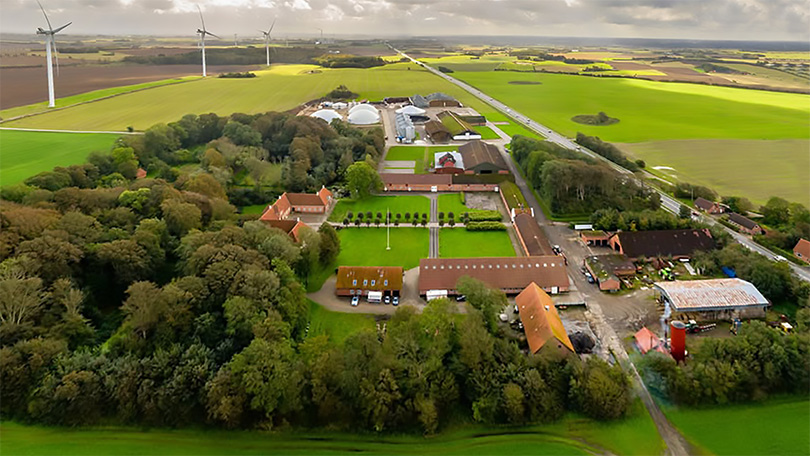
The beautiful old historic manor, Ausumgaard, is located on a hill beside the main road between Struer and Holstebro.
The household consists of Kristian and Maria, along with their three children, Sigrid, Solvej, and Rasmus. They live in the main building, from where they run a modern farm with a strong focus on sustainability and renewable energy, while also working on new concepts and niche products. Kristian is a trained farmer, and Maria is a psychologist with her own practice in Huset Lindskov, just east of Ausumgaard. All three children attend Hjerm School, which is nearby.
Since Maria and Kristian took over the farm in 2008, it has seen rapid development towards increasingly green and sustainable production. The crop area spans 700 hectares, which was converted to organic farming in 2018.
Most recently, chicken production has been leased out (previously, they produced up to 500,000 broiler chickens).
As a relatively new business area, they are currently producing mealworms in collaboration with the Danish Technological Institute under the InValuable project. Whether the production will become permanent at Ausumgaard remains to be seen, but the owners are participating because it aligns with their broader sustainability efforts.
As part of their broader crop production, they also have a small-scale niche production of bread grains, which are processed into flour and sold directly.
Today, the pig stables are leased to a breeding and multiplication herd. This means that they now only produce about 200 pigs per year themselves, under the name “Ausumgaardgrisen”.
Green energy.
The old manor has undergone a significant transition: After many years of animal production, the focus is now on crop farming and the production of green energy — especially biogas and wind power.
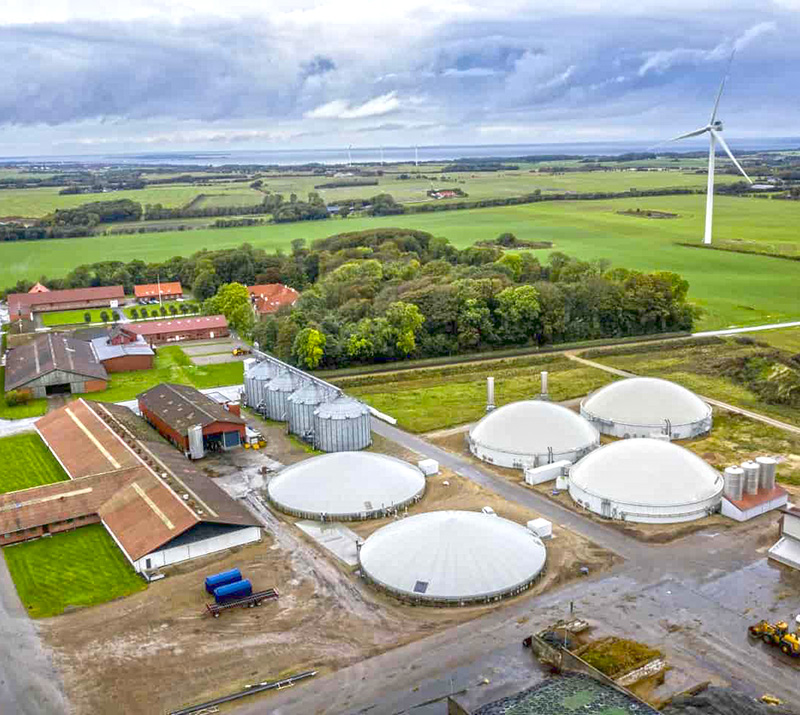
The biogas plant is situated just south and southeast of Ausumgaards existing production buildings, where two reactor tanks have been constructed to the east of the existing slurry tanks. These have a capacity of 2 × 5,200 m³, are located about 3 m below ground, and extend 4 m above the surface. Both reactor tanks are equipped with gas storage domes. The total height is approximately 12–14 m.
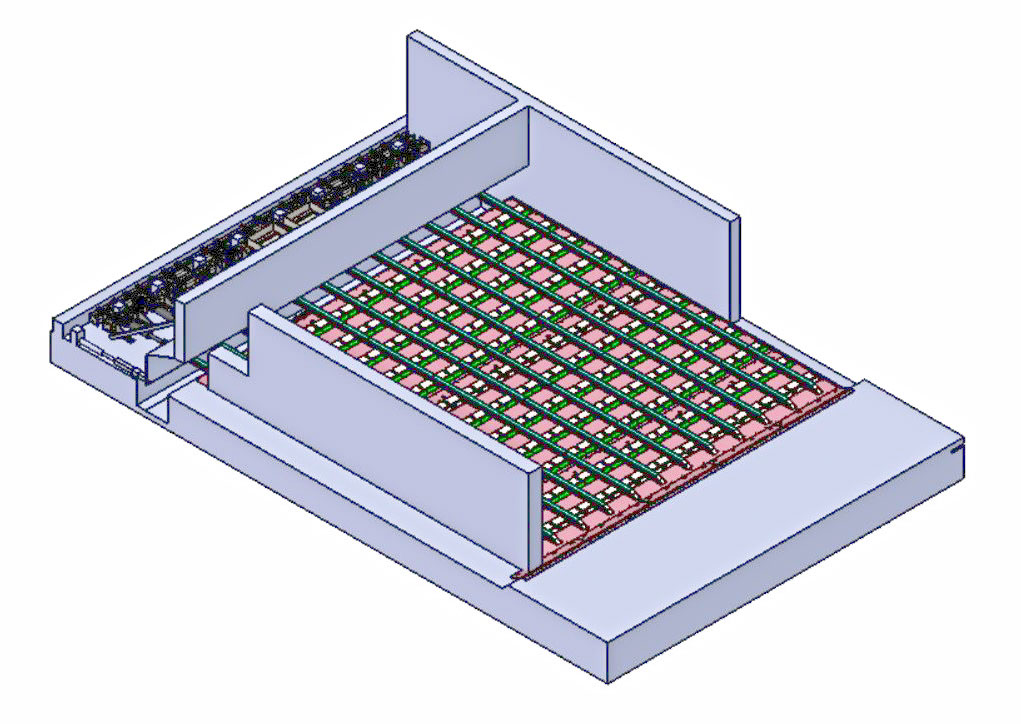
South of the reactor tanks lies the technical building, which houses control panels and pumps, as well as the biogas plant’s feeding system, which resembles a sunken truck trailer / “Walking Floor” (older farmers might liken it to a silage wagon).
Between the main road and the technical building is a large area used for storing biomass for the plant.
Access to the facility is via Ausumvej, past Ausumgaards existing weighbridge and on to the biogas plant.
Since 2017, Ausumgaard has produced biogas, which is upgraded to biomethane and fed into the national gas grid. Although biogas has many applications, this is the solution used on the farm.
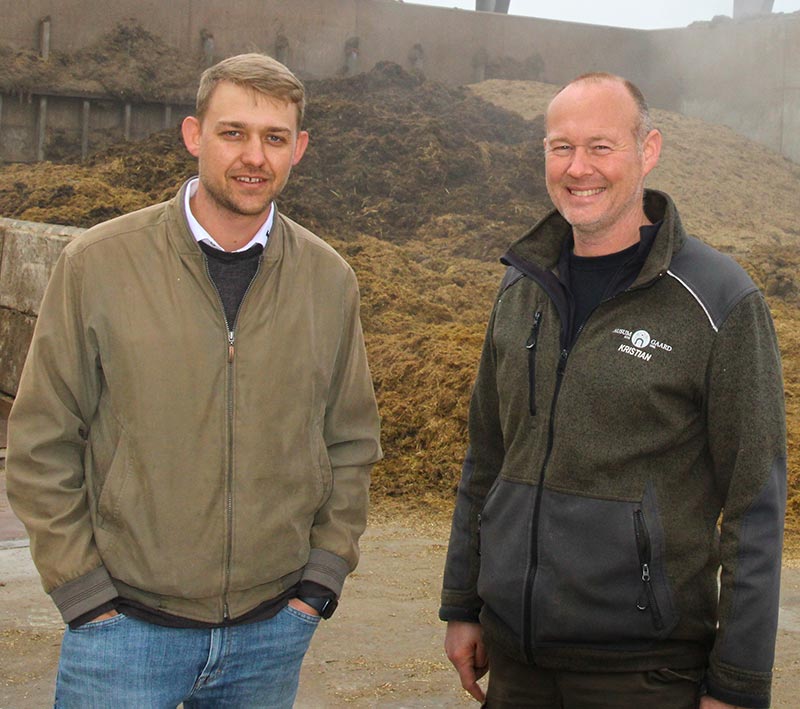
Lars Visgaard Jørgensen, Business development at Linka Energy A/S and Kristian Lundsgaard, owner of Ausumgaard Biogas.
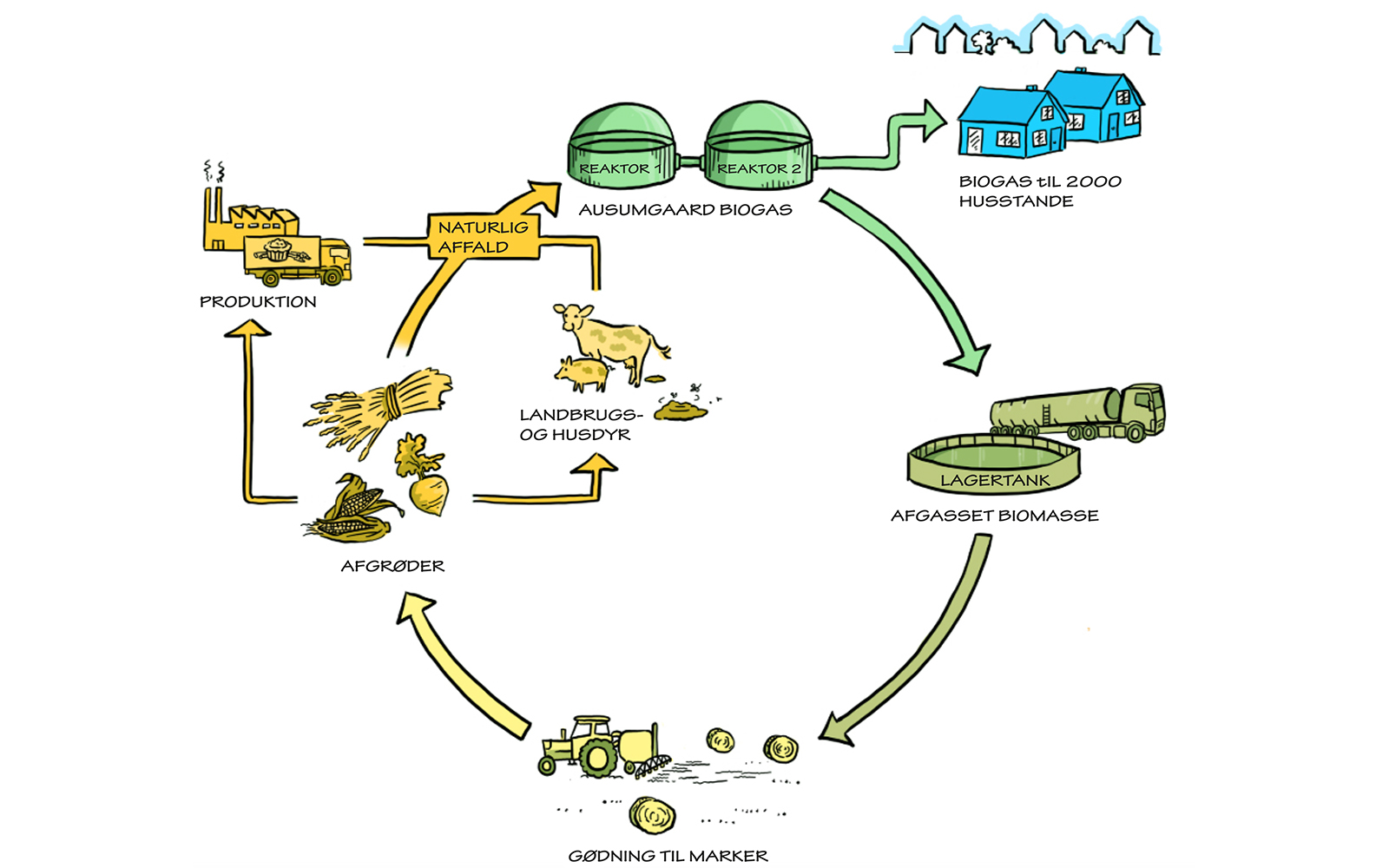
”We produce the equivalent of the annual heating demand of about 4,700 households and feed the biogas plant with biomass and by-products from agriculture, food, and energy production. In this way, we create sustainable energy from materials that would otherwise be difficult to use or potentially go to waste,”
explains Kristian Lundsgaard.
Biogas production at Ausumgaard not only creates green energy — it also delivers a valuable resource back to agriculture. Once the gas has been extracted, the degassed biomass is returned and used as fertiliser. The liquid residue from the process is much easier to apply precisely to crops than traditional deep litter manure, which is typically spread on the surface or before ploughing.
Additionally, the degassed biomass contains nutrients in a form that plants can more easily absorb. This results in more efficient nutrient use, fewer odour problems, and higher fertiliser value — benefiting both farm finances and the environment.
With this effective nutrient utilisation, many farmers can also reduce their use of synthetic fertilisers. This strengthens economic sustainability and supports the circular principles of modern food production.
Livestock farmers with deep litter from calves, dairy cattle, or poultry can particularly benefit from the solution. They can supply their manure to the biogas plant and receive degassed biomass in return — as part of a local, green cycle.
Biogas creates multiple synergies with agriculture.
The biogas plant also provides crop farmers with the opportunity to grow biomass for sale to the plant. This biomass may consist of energy crops such as maize or beets (though these are being phased out), but it may be even more relevant to supply straw, grass, ensiled seed grass straw or other “by-products” from crop production that gain greater value through use in biogas production
— especially if the degassed biomass is returned and spread on the fields.
”We’re constantly trying to stay up to date with new opportunities and new feedstocks, which is why we are increasingly focused on grass as maize is phased out,”
says Kristian.
Automatic feeding of the reactors.
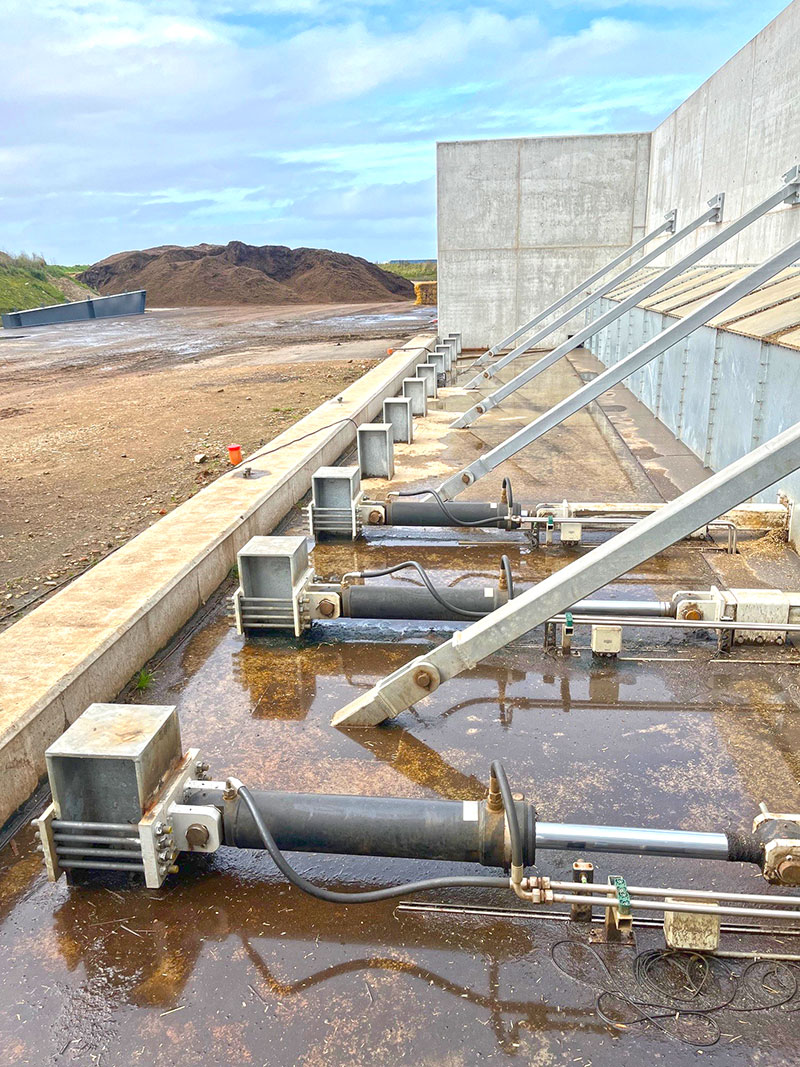
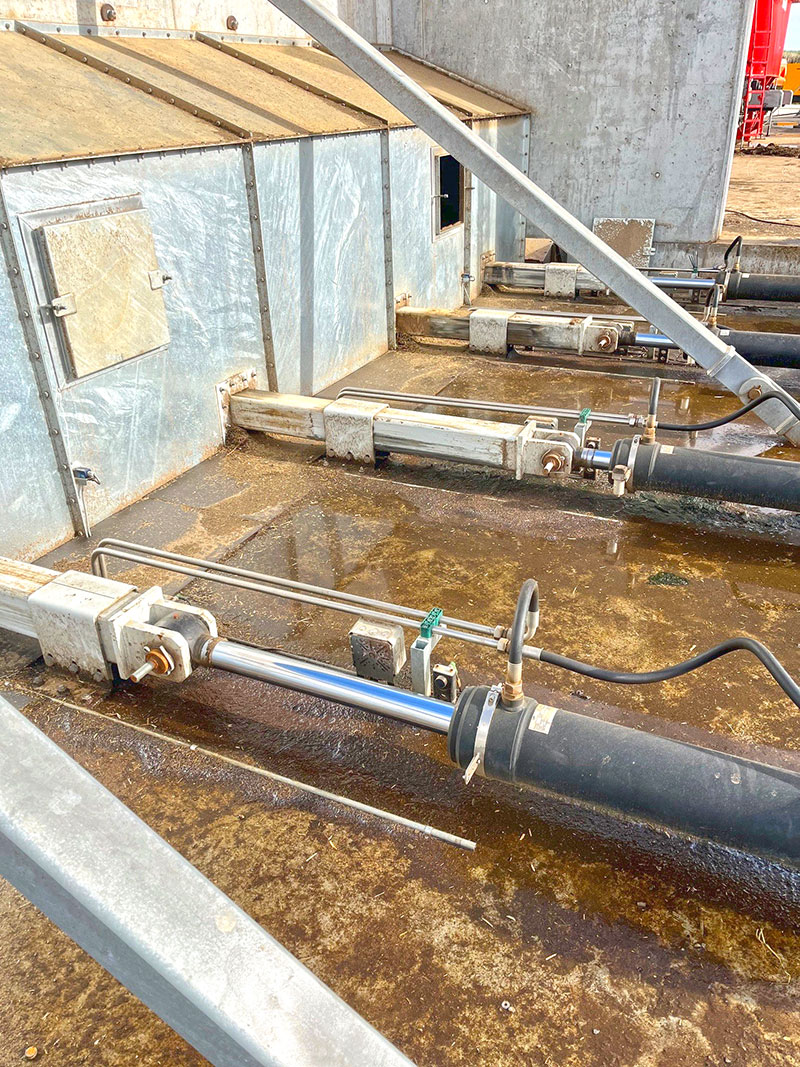
The latest investment at Ausumgaard is a so-called Walking Floor system from Linka — a highly robust and reliable solution designed to handle even the heaviest feedstocks.
The system is installed in the silage pits and can be filled up to four metres high. It has the capacity to deliver up to one tonne of material per minute. Based on an assessment of the feedstock properties, the material quality and strength have been designed for a density of 600 kg/m³.
This is a heavy-duty model that ensures stable and continuous delivery to the reactors — even under high pressure and with heavy biomass.
”In addition to the extra strength, a Hardox plate floor has been installed under all scrapers to ensure extreme durability,” says Lars Visgaard Jørgensen, Project Sales and Business Developer at Linka Energy. He continues: “We had a very productive project phase with Ausumgaard, where both parties contributed input to ensure we achieved the optimal solution.”
This solution is for those who want to avoid all the alarms associated with large crane systems and already use a wheel loader on-site, which can feed the silage pits where the Walking Floor system is installed.
The system has a capacity for 1.5 days of continuous operation.
Text and photo: Kris Vetter.

”We feel our requirements were well heard and incorporated into the design, resulting in a strong and reliable solution. There’s no doubt the system works well, and we have high expectations for our return on investment,”
says Kristian Lundsgaard – the satisfied farmer and biogas operator.
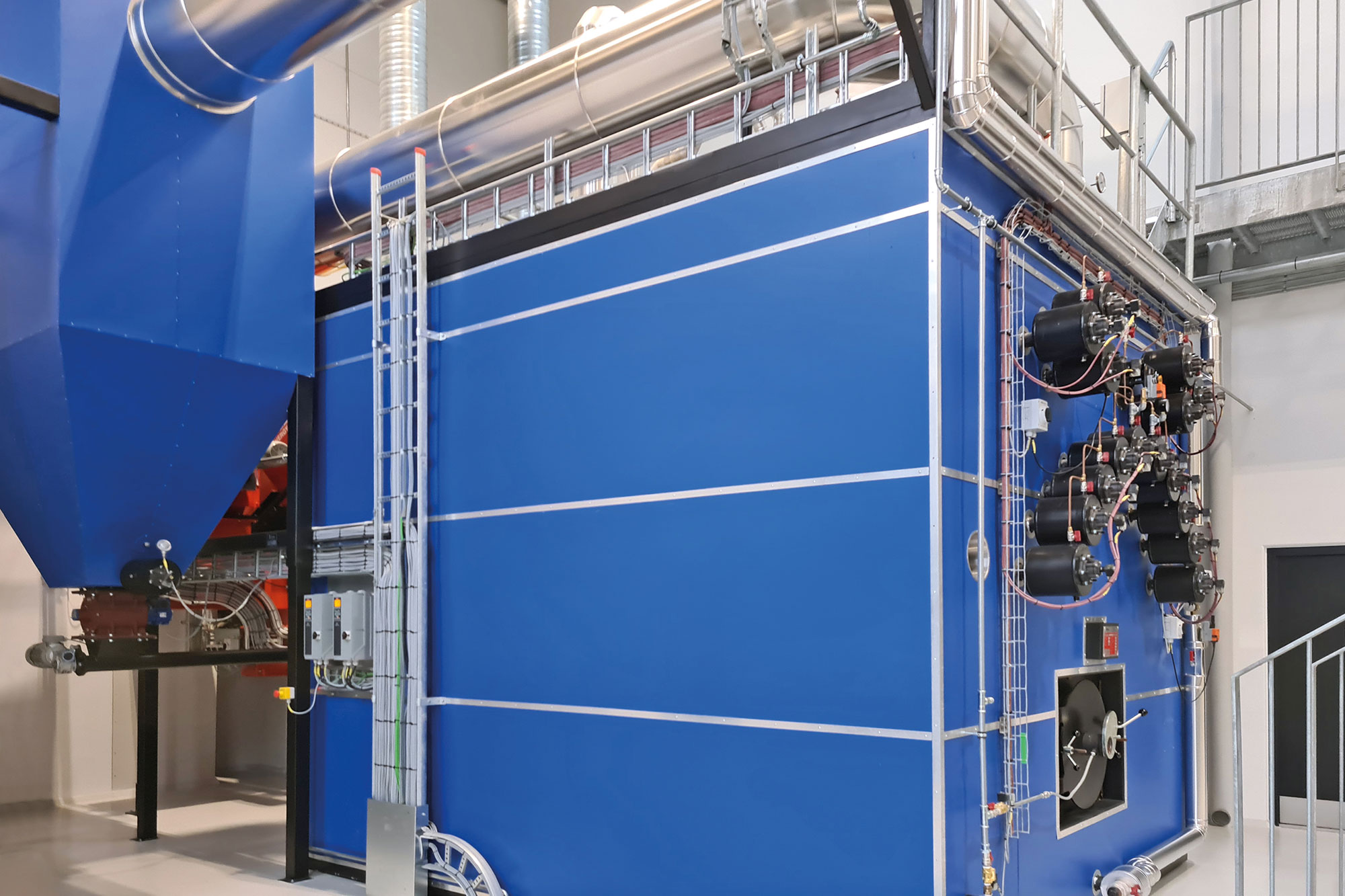
Combi Boiler
Combi Boiler for biomass plants
Flexible, sustainable, and environmentally friendly boiler system that optimizes operation with multiple fuel types.
Combi Boiler for all purposes
Linka Energy specializes in the development and production of biomass plants, including combi boilers that can be used for both industrial processes and heating purposes. The combi boiler is characterized by its efficiency, durability, and ability to deliver sustainable energy using renewable, CO2-neutral fuels.
A combi boiler from Linka Energy is a biomass boiler designed to handle various types of fuel, such as wood pellets, wood chips, grain, or other biomass products.

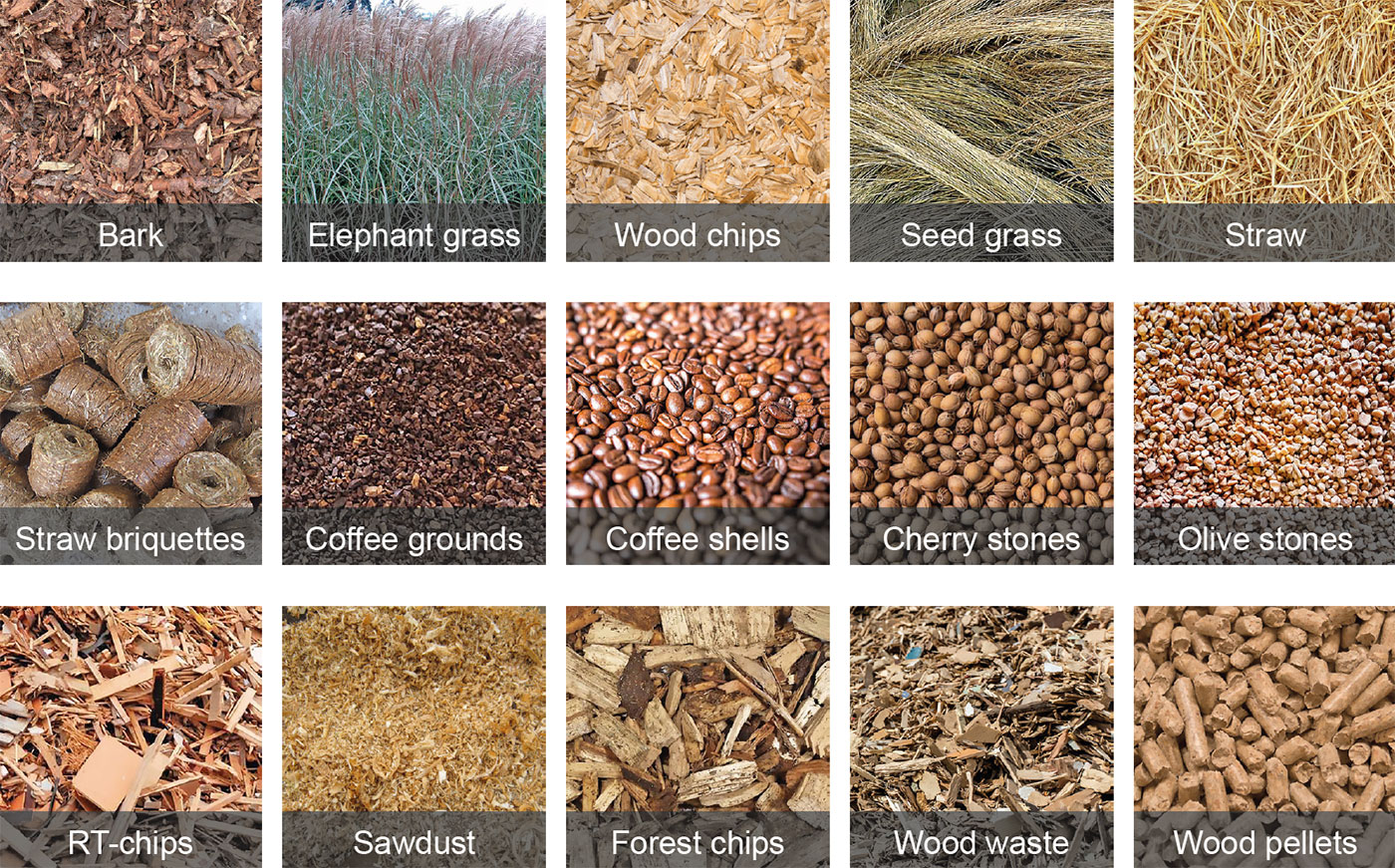
By being able to use different types of fuel, a combi boiler can optimize operation depending on which fuel is most economical or available at a given time. This makes it ideal for both small and large installations where a competitive, flexible, and environmentally friendly solution is needed.
The combi boiler is therefore ideally suited for applications requiring a highly dynamic and adaptable energy solution.
Flexibility vs. specialization
The combi boiler from Linka Energy is designed with several key features that allow the efficient use of different fuel types. Here are some of the most important design features:A mono-fuel boiler is designed for a single type of fuel, whereas the combi boiler can use various types of fuel,
providing greater operational flexibility. This flexibility can lead to economic benefits and makes it easier to adapt to changes in fuel prices and availability. The only thing that matters is that all fuels have a reasonably consistent moisture content.
The primary technological distinction lies in fuel adaptability, with the combi boiler incorporating advanced systems for fuel feeding, air supply regulation, and combustion control, allowing it to optimize combustion across multiple fuel types.
The combi boiler from Linka Energy is designed with several key features that allow the efficient use of different fuel types. Here are some of the most important design features:
- Upgrade of the boiler system to 3-pass and 5-pass configurations, resulting in:
- A reduction in flue gas temperature.
- An increase in efficiency.
- Fuel consumption savings.
- Flexible fuel feeding: The combi boiler can be equipped with either a single or dual feeding system capable of handling various types of biomass fuels, such as wood pellets, wood chips, grain, and other biomass products. This system ensures consistent and secure fuel delivery regardless of type.
- Combustion chamber with adjustable air supply: The combustion chamber of the combi boiler is designed with adjustable air supply,which can be tailored to the specific fuel in use. This is crucial for achieving optimal combustion, resulting in high efficiency and low emissions.
- SRO system (Control and monitoring system): The combi boiler is equipped with an advanced control system that monitors and adjusts the boiler’s operation in real-time. The system regulates combustion parameters such as air volume, fuel feeding, and temperature to optimize efficiency and minimize emissions.
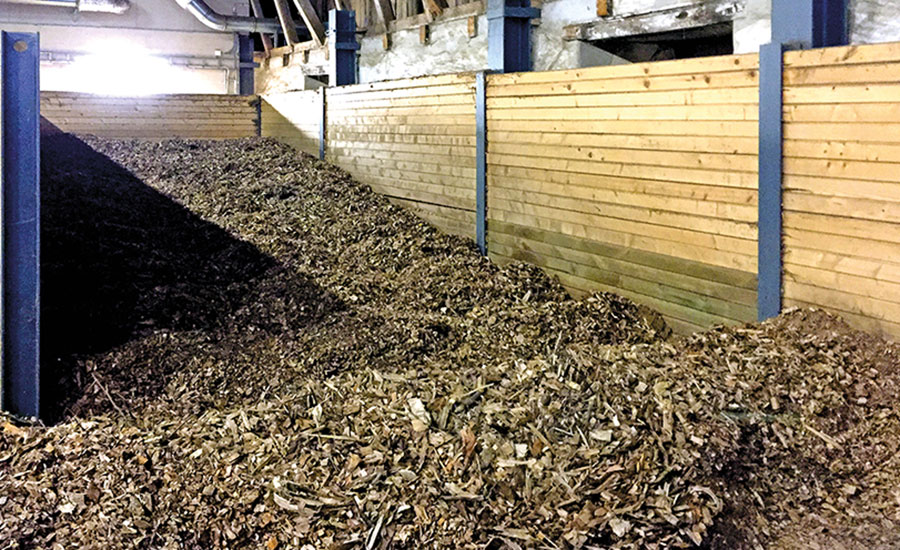
This design makes the combi boiler an adaptable and efficient solution for those seeking a sustainable and reliable heat source that can be adapted to various types of biomass fuels.
The Boiler System
The combi boiler system is based on a Linka® H-boiler with Linka’s patented combustion technology, which ensures maximum fuel utilisation.
It is also equipped with more advanced technology, allowing it to handle multiple types of fuel.
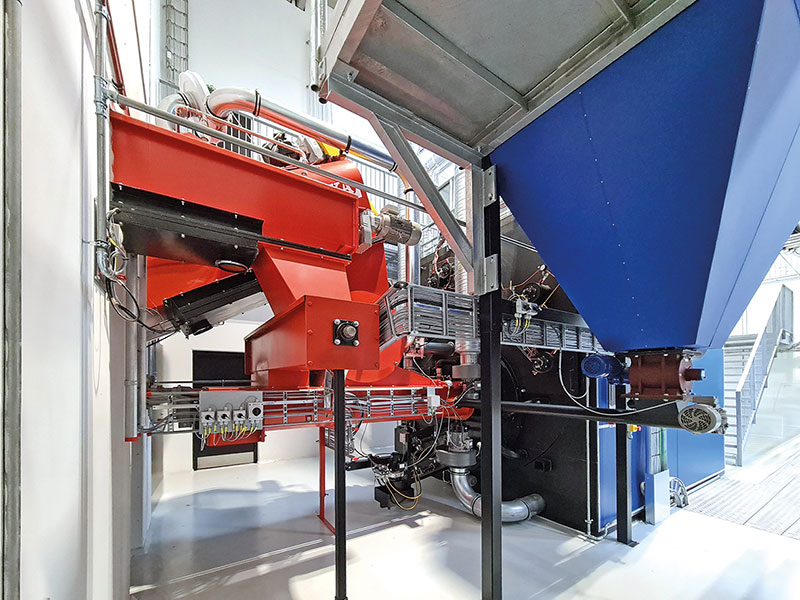
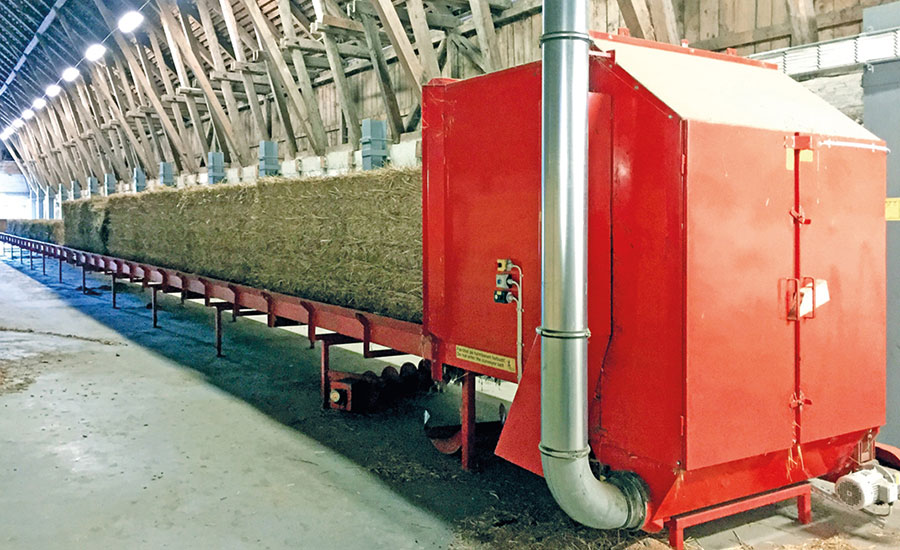
Photos are from Egtved District Heating Plant (left) and Gjerlev District Heating Plant (right).
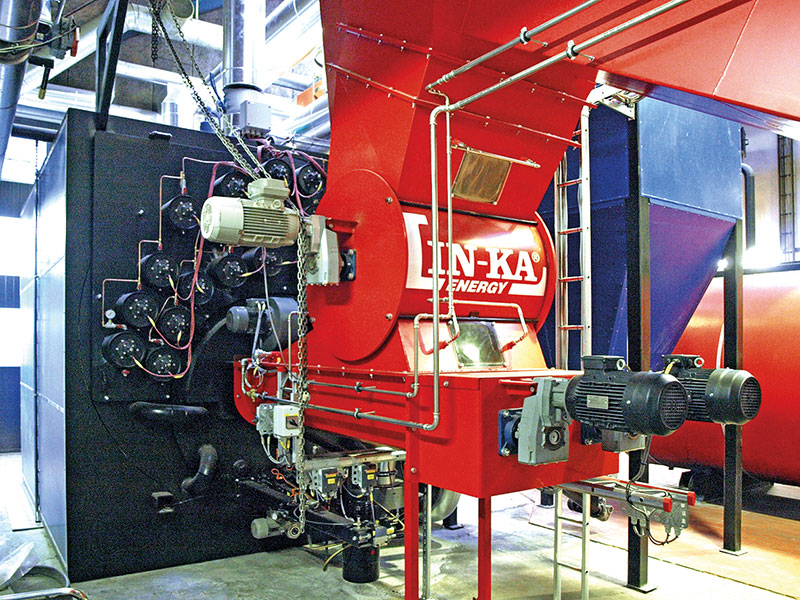
The plant
The Linkas® combi boiler, supplied as a completely new system, is designed and delivered with two independent feeding systems, such as:
- The straw handling system includes a Linka® straw conveyor and shredder, which adjusts the drum speed according to the boiler’s heat demand. The shredded straw is conveyed to the straw auger, through the cell gate, and into the stoker auger, and is then directed to the moving grate at the front of the boiler.
- The wood chip handling system is supplied with a walking floor system/scraper conveyor, which transports the chips via augers. The scraper conveyor features horizontal frames that direct the fuel to a cross auger monitored by photo sensors. If the auger is not fully loaded, the scraper conveyor is activated automatically. The chips are conveyed through the cell gate to the stoker auger and then to the moving grate in the boiler. The system includes both inclined and cross augers.
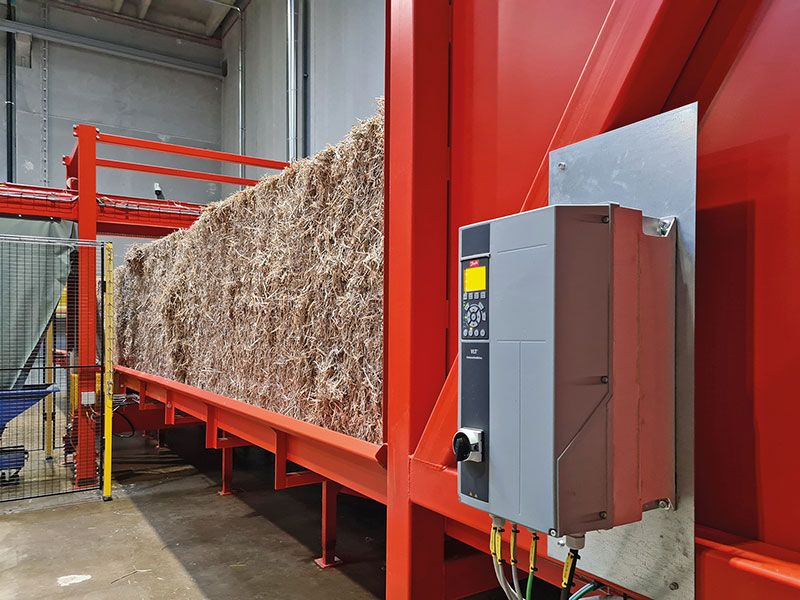
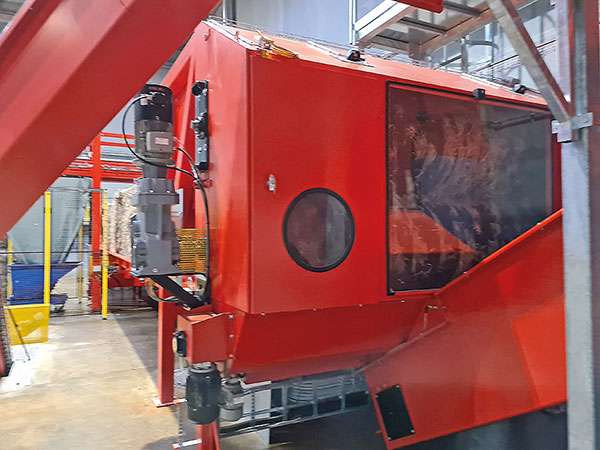
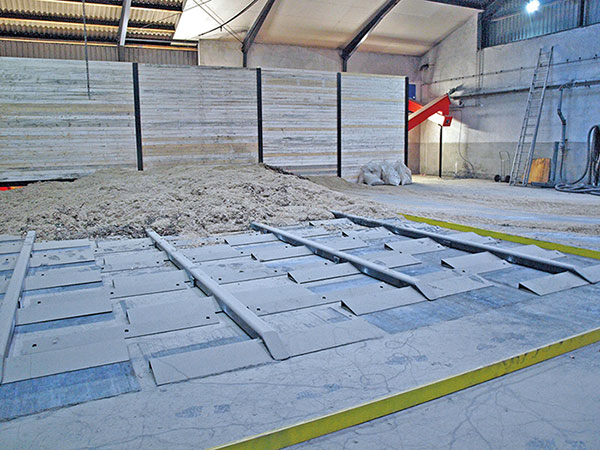
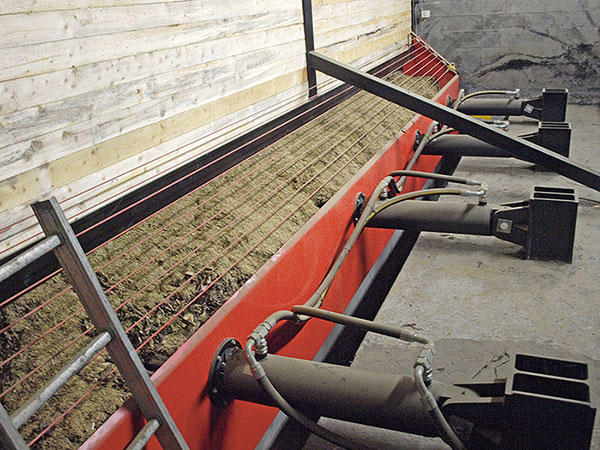
The firing process is activated when the system ”calls” for heat, thus initiating the boiler. This triggers the stoker auger of the boiler to start and simultaneously adjusts the speed to ensure accurate dosing for different fuel types. Once the stoker auger is operational, either the straw handling system or the wood chip handling system is activated, and the system will now supply the boiler with the appropriate amount of fuel for the installed boiler capacity.
Flexibility in fuel types
The Linka Combi Boiler offers you more options.
Linka® electrostatic filter (ESP)
Linka® electrostatic filter (ESP)
An electrostatic filter with an integrated cleaning system that optimizes the purification of flue gases from biomass boilers.
From January 1, 2025, existing medium-sized biomass plants commissioned before December 20, 2018, and with a nominal thermal input greater than 5 MW must comply with the emission limit values for SO2, NOx, dust, and CO as per as per your national executive order for implementation og the MCP-Directive.
The new requirements will include the installation of a filter system in the form of an electrostatic precipitator (ESP) on all biomass plants.
Linka can assist in understanding the directive and the stricter emission requirements positively to create a better environmental image for biomass firing. Linka offers an electrostatic filter with an integrated cleaning system for purifying flue gases from biomass boilers.
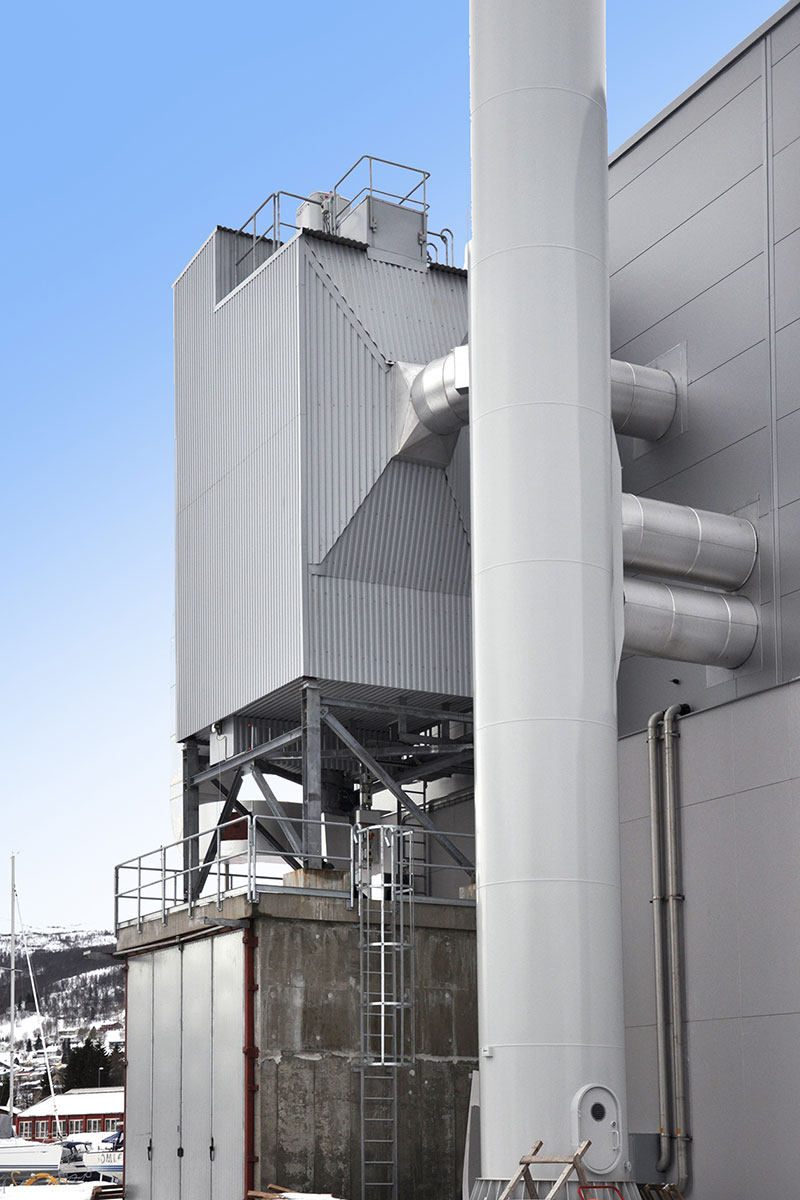
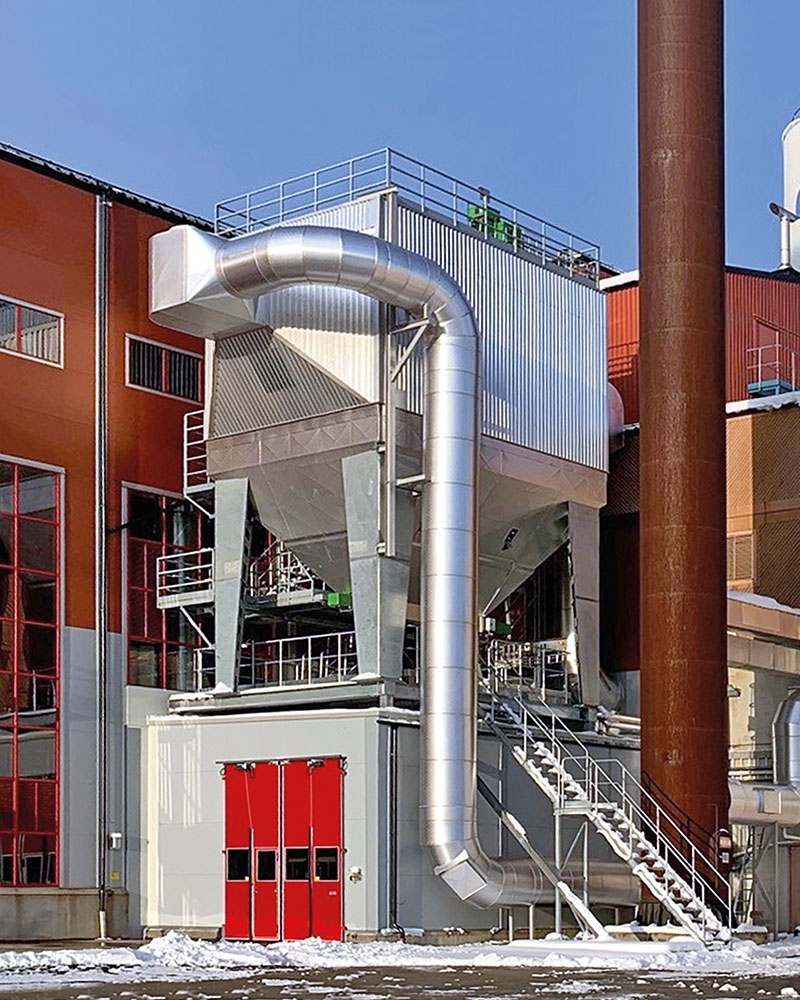
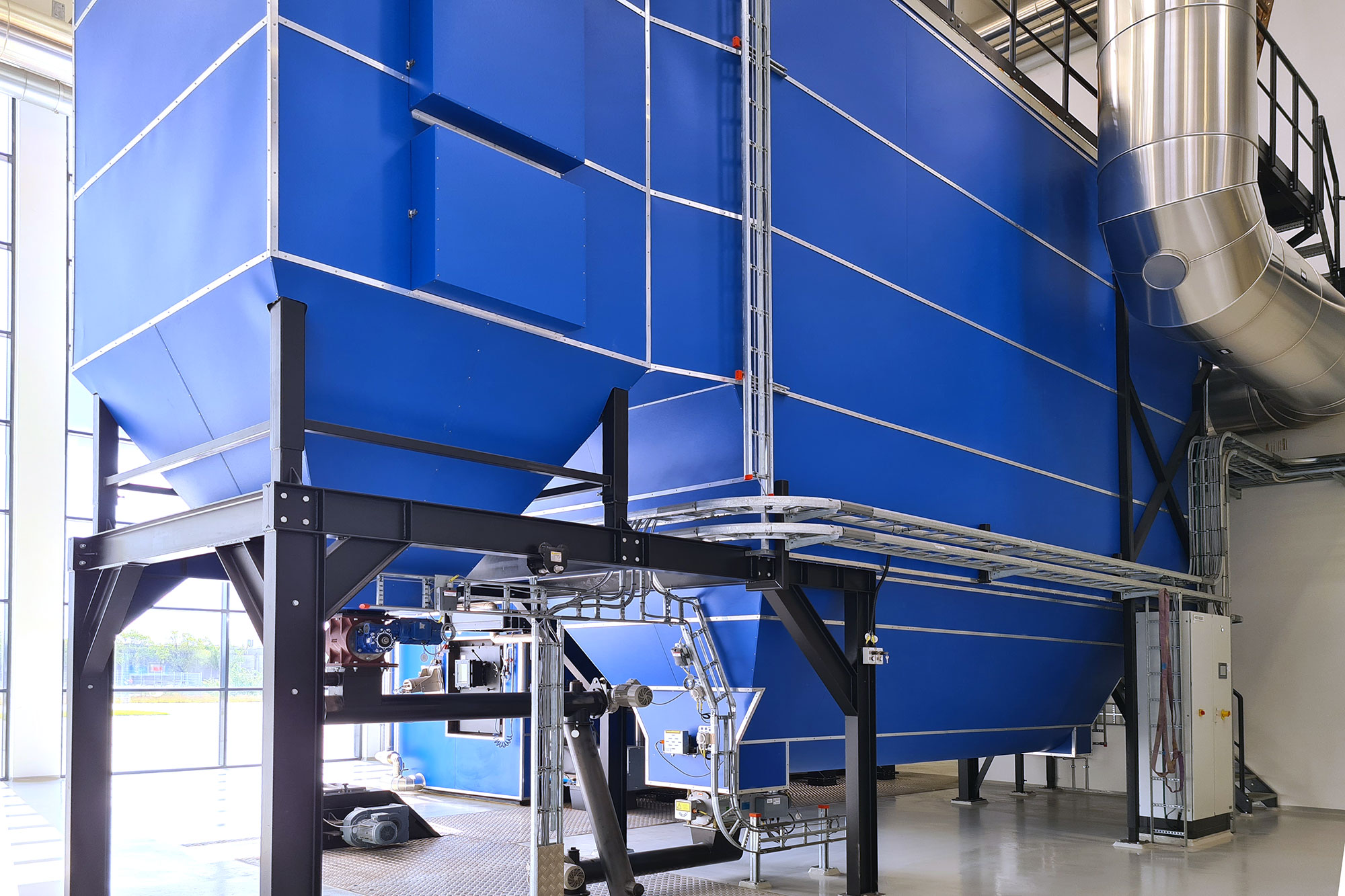
Linka® offers an electrostatic precipitator, also known as an ESP, which removes particles from the flue gas using an electric potential difference.
Facts
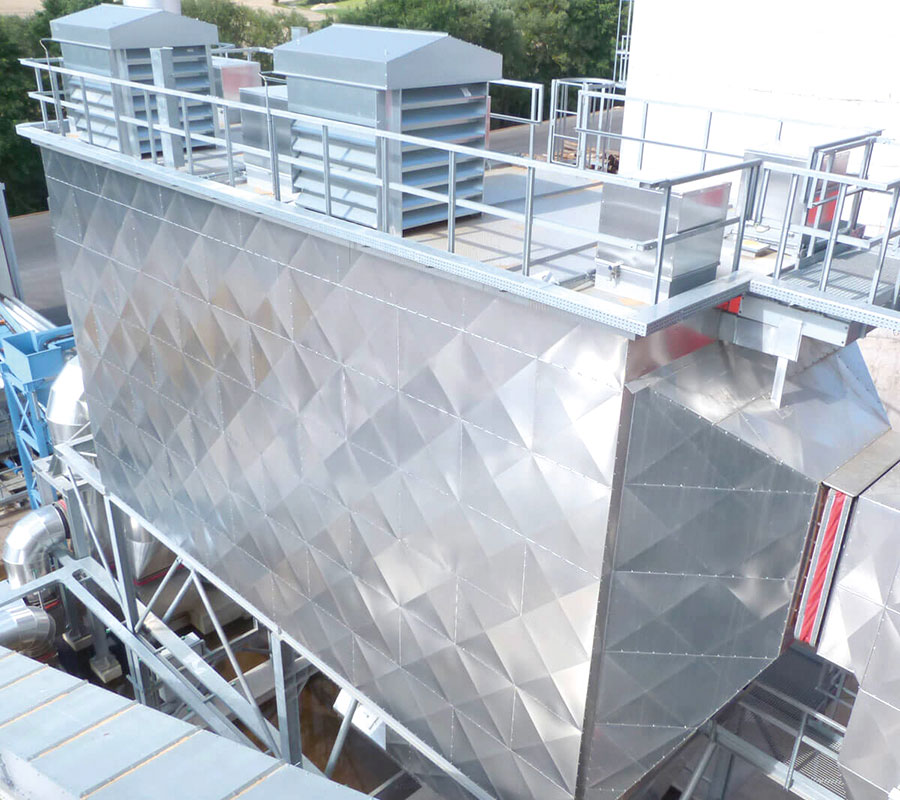
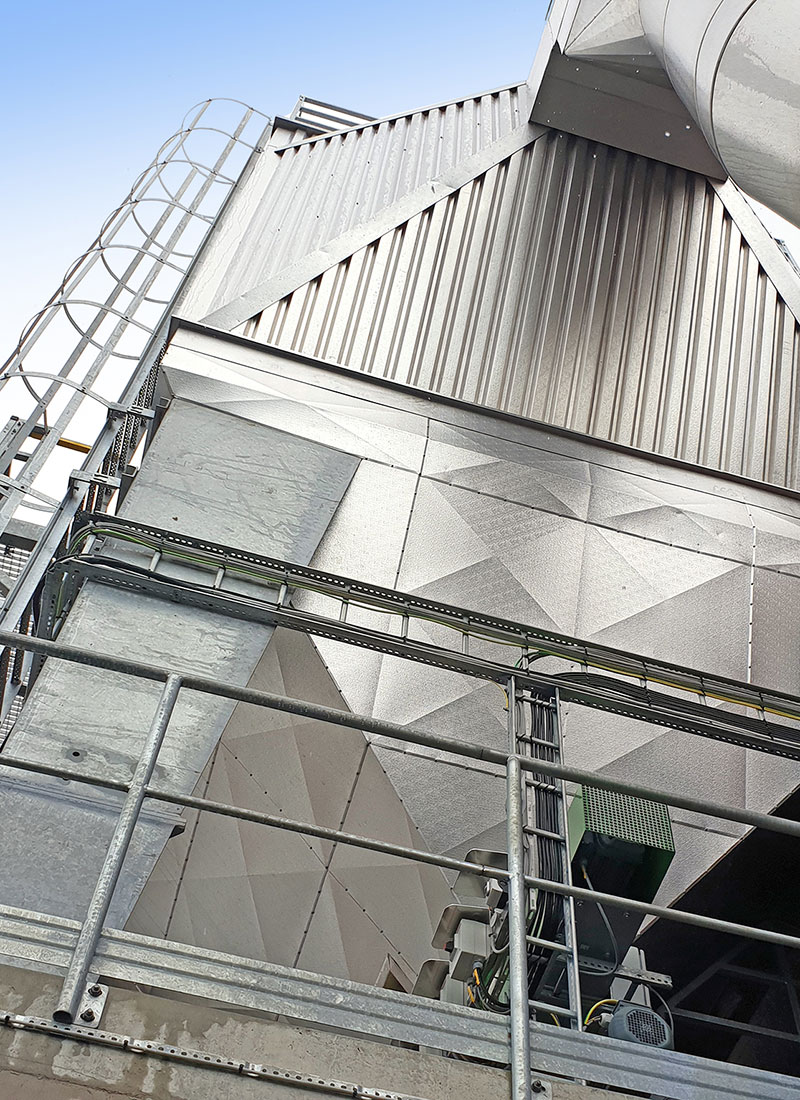
- The filter is delivered as a complete unit, with all wiring, insulation, and cladding done at the factory.
- The filter is equipped with side doors for inspection and service.
- The service area has a handrail installed, and a staircase leading to the ground.
- All exterior surfaces are insulated with mineral wool.
- The cladding is made of aluminium sheets in a colour of the customer’s choice.
- Easy to connect to existing plants that use wood pellets or wood chips. Dust from straw cannot be magnetised.
The energy consumption of the electrostatic precipitator is modest, and it requires only minimal maintenance – as we say at Linka:
Think about the working environment – avoid fly ash in the boiler room.
The technology behind an electrostatic precipitator (ESP)
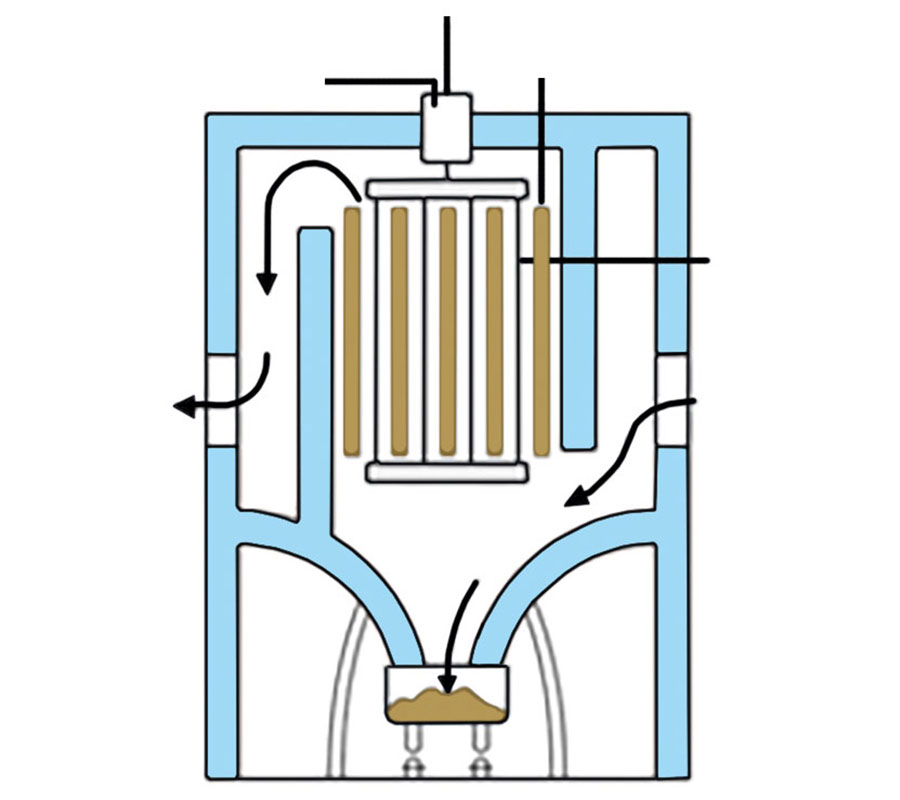
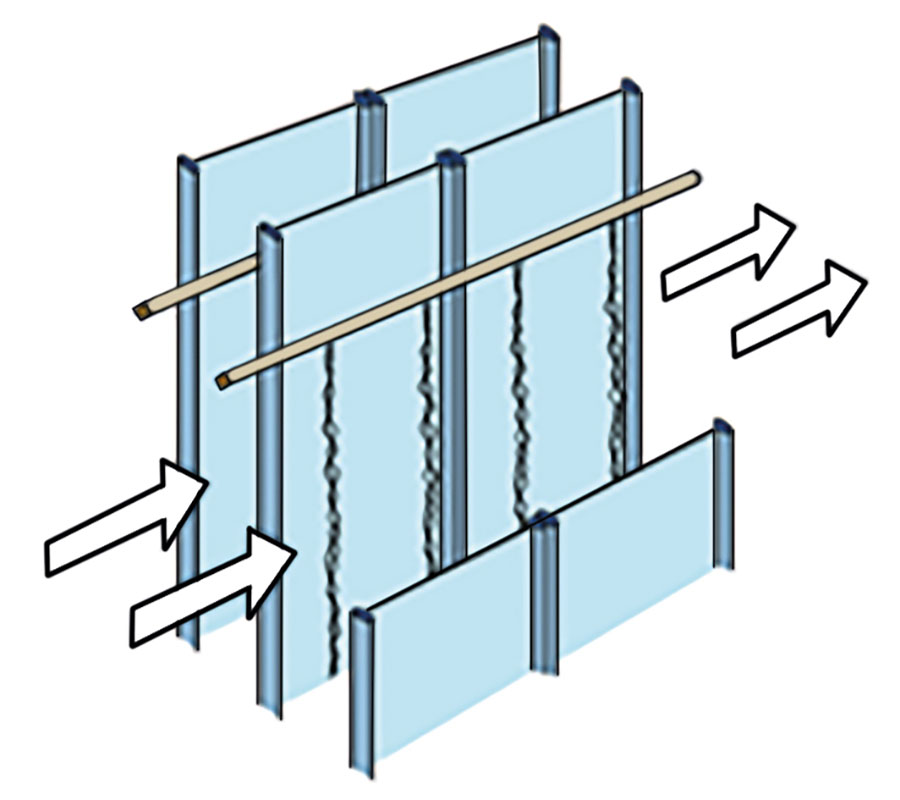
The dust-loaded flue gas is directed through a chamber in the electrostatic precipitator, which is divided into channels by vertical steel plates, also known as precipitation plates. Between the plates, vertical wires are stretched parallel to the plates.
A substantial electric potential difference is applied between the wires and the plates, typically 30-100 kV depending on the distance between them, which gene-rates a weak electric discharge.
This discharge ionizes some of the gas molecules, cau-sing the ions to attach to the dust particles and give them an electric charge. These charged particles are then attracted to the plates, where they are held.
The plates are periodically vibrated, causing the dust to fall into the bottom silo of the filter. From here, dust and ash particles are discharged via an ash auger to the common ash system.
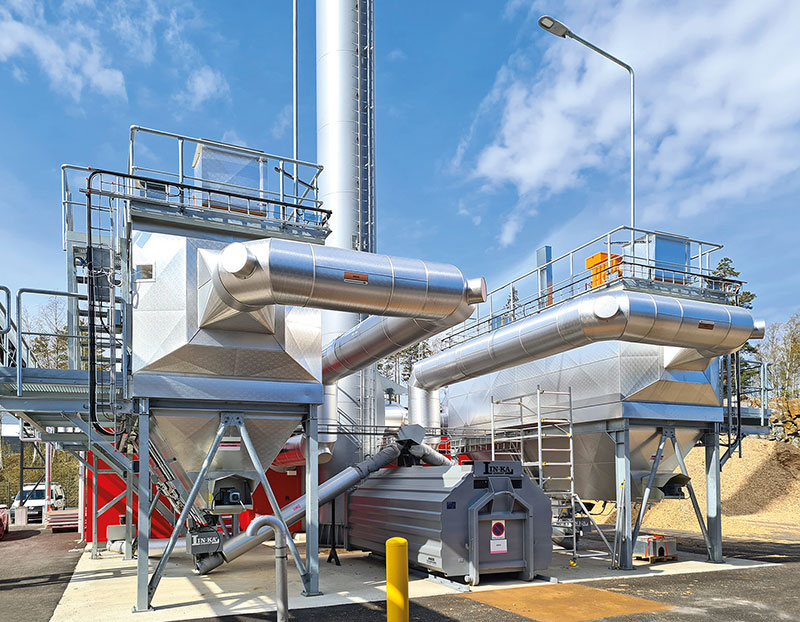
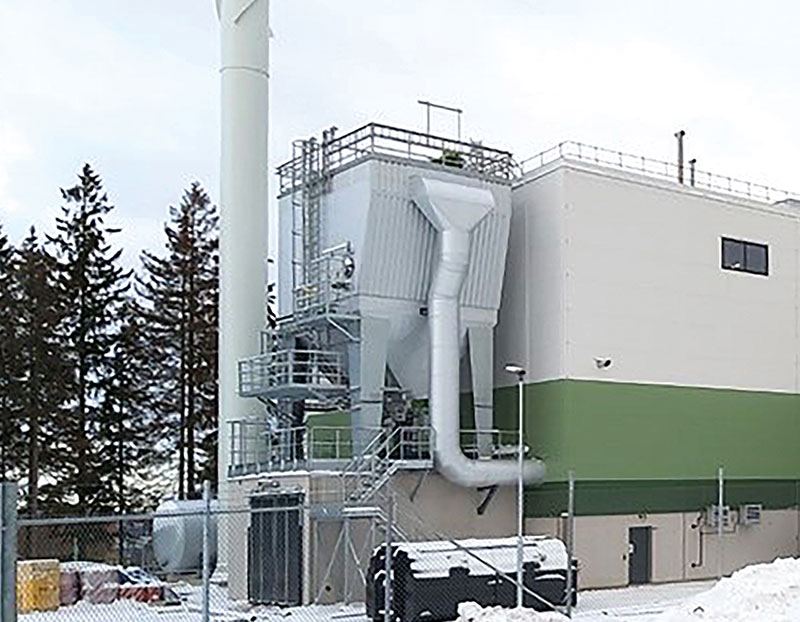
The electrostatic precipitator is one of the most effective methods for removing very fine dust. The increasing requirements for flue gas cleaning have led to higher demand and usage in various processes, including the district heating sector. The energy consumption of the electrostatic precipitator is low, and the maintenance requirement is minimal. The filter is insulated with 100 mm of insulating material and clad with aluminium sheets in a standard colour.
After the flue gas has passed through the filter, the dust emission is reduced to an absolute minimum. The noise emission from the electrostatic precipitator’s “hammers” is less than 70 dB(a) and will be further noise dampened.
After the filter, the flue gas is directed through a frequency-controlled flue gas fan to ensure optimal discharge through the chimney.
Advantages
Linka® recommends an electrostatic precipitator for wood chip/pellet-fired biomass plants because it:
- Cleans automatically and is controlled via a valve control system.
- Is inexpensive to operate.
- Requires minimal supervision.
- Is an investment that can pay off over time.
- Is easy to integrate with an existing plant.
Linka Energy is dedicated to the green transition in both industrial companies and agriculture.
Linka Energy supports the green transition of the industry, promoting sustainable industrialisation worldwide.
Linka helps the energy sector, industry, and agriculture utilise local resources, so together we can create more sustainable cities and communities.